US-based Hindu group criticises Modi over temple’s inauguration


 0
0


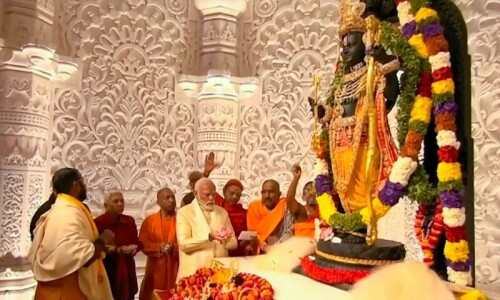
THE inauguration on Monday of Ram Temple, built in Ayodhya 32 years after a Hindu nationalist mob demolished the Mughal-era Babri Masjid, drew criticism from home and abroad alike.
A prominent US-based Hindu group accused Indian Prime Minister Narendra Modi of ‘weaponising’ their faith and using the Ram Temple for political gain, CNN reported.
“The Ram Temple is being built on the ruins of a sacred medieval mosque destroyed by a Hindu nationalist mob, on a long contested holy site in India,” a statement from Hindus for Human Rights said.
“Objections include the fact that Mr Modi is not a religious leader and so not qualified to lead the [inauguration] ceremony, and that a Hindu temple cannot be consecrated before it is completed,” the statement said. “Mr Modi rushing through and fronting it himself is the latest attempt to weaponise Hinduism in the name of the BJP’s repressive nationalist ideology, ahead of national elections in May,” it added.
Hindus for Human Rights is a US-based non-profit advocacy group founded in 2019 that advocates for pluralism, civil and human rights in South Asia and North America, according to its website.
The BJP’s main opposition, the Indian National Congress, said the event is being politicised by the ruling BJP.
Responding to the Congress’s decision to miss the ceremony, BJP spokesperson Sudhanshu Trivedi told reporters it was driven by “jealousy, malice and inferiority complex towards Prime Minister Narendra Modi,” adding that the party is opposing the ‘country’ and ‘god.’
Some prominent Muslim lawmakers also criticised the inauguration of the temple, lamenting the loss of the Babri mosque where their ancestors recited the Holy Quran hundreds of years ago.
“Young people, we have lost our Masjid (mosque) and you are seeing what is being done there,” said Asaduddin Owaisi, chief of the All India Majlis-i-Ittehadul Muslimeen political party, to his followers during a speech earlier this month. “Don’t you have pain in your hearts?”
Moreover, an Indian journalist Betwa Sharma said in a conversation with Al-Jazeera: “If you celebrate while someone else is in pain, something is broken in our society.”
Nilanjan Mukhopadhyay, author of The Demolition and the Verdict, a book about the 1992 mosque demolition, said Mr Modi’s decision to preside over Monday’s festivities is a sign of “Hindu hegemony” in India.
“Lines between politics and religions have got blurred,” he said of Mr Modi’s involvement in the ceremony in a country that is constitutionally secular.
“They have also got completely blurred between religion and the Indian state. You have at the moment the Indian prime minister who is actually participating in a purely religious activity, with full participation of the government machinery.”
Published in Dawn, January 23rd, 2024