KDA plans mega housing scheme on 14,000 acres near Karachi’s Northern Bypass


KARACHI: The cash-strapped Karachi Development Authority (KDA) is planning to approach the Sindh government for allotment of thousands of acres along Northern Bypass for a mega housing scheme that would not only make the authority financially viable but also help in restoring its past glory.
Well-placed sources told Dawn that around two years ago the KDA board of governors had accorded approval for preparation of the new housing scheme, but the matter remained pending disposal as the state land for the purpose was to be acquired from the provincial government.
They said that no land was available within the boundaries of the city and the state land on the outskirts of the city fell within the administrative control of the Malir Development Authority (MDA) or Lyari Development Authority (LDA).
Since its establishment in 1957, the KDA has developed over 700,000 plots in 45 housing schemes, out of which four schemes — Shah Latif Town, Hawkesbay, Taiser Town and Halkani Town — were transferred to MDA and LDA in 1993.
The schemes transferred to the MDA and LDA, however, didn’t bring required results as the development infrastructure was yet to be developed despite passing three decades.
Caretaker CM, BoR to be approached for allotment of state land, says director general
Talking to Dawn, KDA Director General Naveed Anver said that a summary would be moved to the chief minister soon for allotment of over 14,000 acres in the Northern Bypass area to the KDA on concessional rates, to be paid in four equal instalments, for the housing scheme.
He said that the Board of Revenue (BoR) would also be requested to provide ownership details of private land in Deh Mithaghar and Deh Mahio for the purpose of acquisition.
He said that the demand for housing had been increasing for the past many years and estimated 100,000 new residential units were needed in the city every year to meet the demand.
“However, the formal sector can provide hardly around 32,000 housing units, while the remaining units are dealt by informal settlements or shanty towns,” he added.
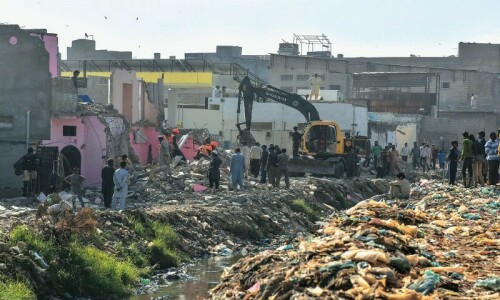
Mr Anver said that the only option available to low-income citizens to get rid of Katchi Abadis was to occupy a decent shelter on a rental basis.
Quoting a KDA report, he said that total area of the city was around 3,800 square kilometres, of which only 1,350 sq-km was considered residential and about 1,000 sq-km was formally built for a population of 100 million, while the remaining 350 sq-km catered to the housing demand of the remaining people.
He said that on average 10 people were staying in a single room in the city resulting in unhygienic conditions and conflicts. “Moreover, the families living in slums are more vulnerable to epidemics because of unhygienic conditions.”
Mr Anver said that the KDA was facing a severe financial crisis as it had to pay the salaries and retirement dues to its employees.
He said that the KDA had approached the caretaker provincial government for a one-time grant of Rs2 billion to clear the outstanding dues of employees. “Besides, we are also working to auction some plots to generate funds for payment of pension dues of our employees,” he added.
Published in Dawn, January 2nd, 2024