0
0

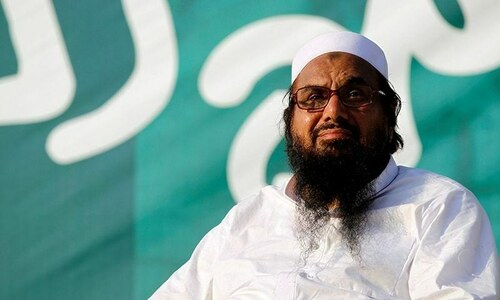
India has formally requested Pakistan to extradite Hafiz Saeed, suspected of involvement in the 2008 attacks on Mumbai, for trial in India, foreign ministry spokesperson Arindam Bagchi told reporters in a briefing on Friday.
“We have conveyed a request along with relevant supporting documents to the government of Pakistan,” Bagchi told reporters.
Reached out for comment by Dawn.com, Foreign Office Spokesperson Mumtaz Zahra Baloch said Pakistan received a request from the Indian authorities seeking Saeed’s extradition in a “so-called money laundering case”.
She added that “it is pertinent to note that no bilateral extradition treaty exists between Pakistan and India.”
Questioned about the extradition request during her weekly press briefing on Thursday, Baloch had said: “This question is based on speculative reporting and we would not like to comment on speculative reports.”
Saeed, a hardline cleric accused by the US and India of orchestrating the 2008 Mumbai attacks, has been a well-known, albeit shadowy, figure in Pakistan since the 2000s.
Though his media presence has dwindled over the years, the past decade has seen Saeed in and out of the limelight owing to crackdowns by the government on his organisation Lashkar-i-Taiba (LeT) and its charity wing, Jamaat-ud-Dawa (JuD), due to mounting international pressure.
According to the BBC, Saeed founded the LeT in the 1990s; when it was banned, the revival of Jamaat-ud-Dawa wal-Irshad — a much older organisation — was witnessed in 2002 when it was renamed Jamaat-ud-Dawa.
Though the JuD leader insists his organisation has worked for Islamic welfare, especially in the aftermath of natural disasters, the United States has maintained that the group is a front for militant activities.
In early 2017, the federal government launched a crackdown against the JuD, placing Saeed under house arrest. However, Saeed was released in November 2017 after the Lahore High Court refused to extend the period of his confinement.
In 2018, Pakistan endorsed the United Nations’ list of banned terrorist organisations by extending the ban on the outfit in Pakistan as well. Prior to this, the Securities and Exchange Commission of Pakistan had barred JuD and several other such organisations named in a list of banned outfits by the United Nations Security Council from collecting donations in the country.
The country-wide ban was imposed after former president Mamnoon Hussain amended the Anti-Terrorism Act (ATA), 1997 and issued the amended Anti-Terrorism Ordinance, 2018.
The JuD chief was arrested once more by the Counter Terrorism Department (CTD) in July 2019, while he was travelling from Lahore to Gujranwala. Prior to his arrest, 23 first information reports were registered against JuD leaders, including Saeed and JuD Naib Emir Abdul Rehman Makki, at police stations in Lahore, Gujranwala, Multan, Faisalabad and Sargodha.
An anti-terrorism court awarded him a combined sentence of 33 years imprisonment in April 2022 in two cases of terror financing registered by the CTD.