PESHAWAR: The Khyber Pakhtunkhwa government has started cultivation of saffron on commercial basis in different parts of the province for the first time to diversify livelihood of farmers and fetch premium price for their product.
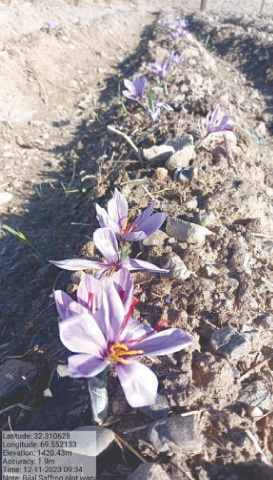
The cultivation of saffron over 23 acres has been started as a joint pilot project of forest department’s directorate of non-timber forest production and agriculture department, according to officials.
Saffron, botanically called crocus sativus, contains a powerful antioxidant and a variant of plant compound having cancer fighting properties.
The directorate of non-timber forest products (NTFP) had experimentally raised saffron over an area of two acre in South Waziristan and Khyber tribal districts. “Its results were successful,” NTFP director Rashid Hussain told Dawn.
The crop has been grown over 23 acres as a pilot project
Later on, he said, a project titled ‘Climate resilience trough horticulture intervention in KP’ was devised in collaboration with agriculture department. The project was financed by World Bank through National Disaster Risk Fund, he added.
Mr Hussain said that the objective of the project was to contribute to climate resilience through introduction of saffron cultivation for efficient utilisation of arable and cultivable wastelands. “In Pakistan, saffron is grown in Khyber Pakhtunkhwa and Balochistan in dry temperature forest zones like Chitral, Dir, South Waziristan, Khyber and upper regions of Swat,” he added.
In order to diversify livelihood of farming communities and fetch premium price for their product, saffron has been cultivated on their arable and cultivable wasteland.
The director of NTFP said that market price of saffron varied from Rs300,000 to Rs500,000 per kilogram. “At least one to two kilograms of saffron dried threads (stigma) can be obtained from one acre of land,” he added.
He said that saffron was grown in the areas with dry temperature climate conditions characterised by cool winters and hot dry summers. He added that Khyber Pakhtunkhwa offered suitable conditions for its cultivation.
Mr Hussain said that saffron was typically grown by planting corms in the month of September and October on sunny well drain soil. “The crop matures in 70 to 90 days and the flowers once started are regularly collected. Later, stigma is separated from flowers and shade dried. One corm of saffron can produce three to five flowers per plant,” he added.
According to reports, he said, Iran was currently the largest producer of saffron. Iran produces 80 to 90 per cent of the world saffron and is known for its high quality. Other countries, which produce saffron, include India, Morocco, Spain, Turkey and Afghanistan.
“Saffron is an expansive spice and KP can benefit from its high value price. It can help to boost the economy of the region and provide additional sources of income and job opportunities to people,” said Mr Hussain.
He said that the directorate of NTFP intended to build capacity of local communities in the targeted areas regarding cultivation of saffron, its harvesting, processing and marketing.
“We are sure that the pilot project of saffron cultivation is successful as the first crop of the saffron has started yield. The cultivation would be extended to other areas of the province in the larger public interest,” he said.
Published in Dawn, December 25th, 2023