0
0


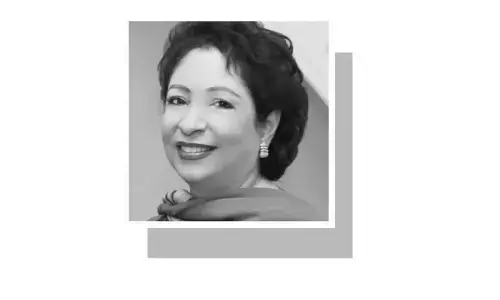
DR Azra Raza’s name — a playful anagram — is nevertheless one of the most universally respected in oncology.
Pakistani by origin, she graduated from Dow Medical College, Karachi, in the 1970s. There, treating a victim dying of cancer — “the emperor of all maladies” — she decided to make that disease her specialisation.
Like many talented Pakistanis who found local institutions a useful springboard only to discover that the pool of future options was empty, Dr Raza migrated to the United States where she joined the Roswell Park Cancer Institute in Buffalo (New York) in 1977. Its motto, composed by a Dr Grace, gripped her: “If I had a choice between a walk on the moon and saving one life from cancer, I would never look at the moon again.”
Rather like Dr Raza, whose husband Harvey Preisler would in time himself die from cancer, it took a personal tragedy — the death of his two-year-old son Jimmy from leukaemia — for Dr Grace to realign his priorities. Dr Grace too made it his mission to find a cure for cancer. He discovered to his chagrin though that the US government committed 400 times more money to the military than to cancer research. (Which country doesn’t?)
In her presentations, Dr Azra leavens science with poetry.
Dr Raza has compressed her research over the past 40 years in cancer prevention and treatment into a moving, readable (even for a layman) book titled The First Cell: And the Human Costs of Pursuing Cancer to the Last (2019). She lectures extensively, drawing attention to her lonely quest to identify and isolate the first cell — in essence, “finding cancer before it finds us”.
She summarises her book in one pithy sentence: “The future is in preventing cancer by identifying the earliest markers of the first cancer cell rather than chasing after the last.”
Synthesizing her experience in the field since 1984, she found that “while there has been little progress in cancer research, there has been even less improvement in treatment”, some of it unchanged since the 1970s. She makes this startling observation: “Since 2005, 70 per cent of approved drugs have shown zero improvement in survival rates, while up to 70 per cent have been actually harmful to patients.”
She notes that in 1977, the survival rate of cancer patients was 26pc. Over 40 years later, despite the billions of dollars spent on research, it has improved only marginally to 28.5pc.
Having seen death too often and too closely, she is qualified to assert: “Dying is not a failure. Denying death is.” It is not shared nihilism that draws her close to the Afro-American writer the late James Baldwin, who mused: “It seems to me that one ought to rejoice in the fact of death by confronting with passion the conundrum of life [.] … It is the small beacon in that terrifying darkness from which we come and to which we shall return.”
Dr Azra borrowed Baldwin’s telling phrase as the title of her recent Yohsin lecture at Karachi’s Habib University: Confronting with Passion the Conundrum of Life.
During her lecture, she explained the uniqueness of her approach. She identifies patients with a high risk of cancer and then monitors them, looking for that first tell-tale symptom. She has analysed that the major causes of cancer are age and stress. According to her, 60pc of cancers diagnosed are cured, mostly by surgery, chemotherapy and radiation. The remaining 40pc are diagnosed but are at too advanced a stage to be salvaged.
Her medical library consists of a tissue bank she created that contains over 60,000 specimens drawn from cancer patients. Her pioneering effort in this type of specialised documentation is now being given the re-cognition (belatedly) it deserves.
In her inimitable, often bilingual presentations, Dr Azra leavens science with poetry, in English and in Urdu. She does not need to search for the appropriate quotation: Rainer Maria Rilke, W.H. Auden, Shakespeare, Allama Iqbal, Faiz and Ghalib wait impatiently to be summoned. She honoured Ghalib particularly by co-authoring a book on him with Sara Suleri Goodyear titled Ghalib: Epistemologies of Elegance (2009).
At a small gathering in Lahore on Dec 11, Dr Azra discussed how the life span of humans has lengthened. Whereas previous generations had a life expectancy of 50-60 years, then 70-80 years, now 80-90, our elders reaching 100 or more, she suggested, should no longer come as a surprise.
“Will a human being live up to 150 years?” she was asked. “Why not?” she replied. “In fact, I suspect that the first person likely to live 150 years has already been born.”
Dr Azra should herself have been born more recently. She would have had at least a century of vital life-saving research ahead of her.
The writer is an author.
www.fsaijazuddin.pk
Published in Dawn, December 21st, 2023