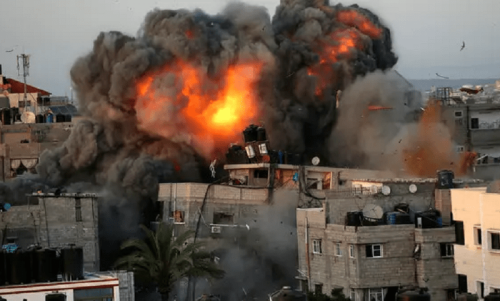
Experts worried Israel could flood tunnels


JERUSALEM: Israel has reportedly started to test a plan to flood Hamas’s sprawling tunnel network, but experts say it is a dangerous option that poses huge risks to Gaza’s besieged civilians.
The Israeli military is determined to destroy the tunnels, and army chief Herzi Halevi has suggested pumping water into them is “a good idea”.
Dubbed “the Gaza metro” by the Israeli military, there were 1,300 tunnels over 500 kilometres in Gaza at the start of the aggression in Oct, according to a study from US military academy West Point.
The maze of tunnels was initially used to bypass Israel’s devastating blockade on the Gaza Strip after Hamas came to power in 2007, allegedly allowing the smuggling of people, goods and weaponry in and out of Egypt.
Since entering Gaza in Oct, the Israeli military has found that the tunnel network is “even more extensive and deeper than they expected,” Raphael Cohen, military expert for the US-based Rand Corporation, said. The Israeli army has found more than 800 tunnel shafts, 500 of which have been destroyed, it claimed this month.
Destroying the tunnels
Israeli media reports that the army is leaning towards flooding the tunnels with seawater pumped from the Mediterranean.
Rand’s Cohen said there are always “second-order consequences” with such tactics. “There’s no good way of destroying a tunnel without affecting the infrastructure above ground,” he said.
Hamas doubts Israel’s ability to destroy the tunnels.
“Those tunnels were built by well-trained and educated engineers, and they have considered any kind of attacks that may happen including bombing and water,” senior Lebanon-based Hamas official Osama Hamdan told a press conference on Thursday.
The narrow Gaza Strip is only between six and 12 kilometres wide and the territory’s water tables were already facing a huge problem from becoming too salty.
That adds to a chronically faulty wastewater system and the “uncontrolled used of pesticides and herbicides in intensive agricultural zones,” said Eilon Adar, from the Zuckerberg Institute for Water Research at Israel’s Ben-Gurion University of the Negev.
Combined, these factors have “had very serious consequences on Gaza’s water quality,” Adar said.
Published in Dawn, December 16th, 2023