Pakistan moves closer to signing landmark trade agreement with GCC



ISLAMABAD: Pakistan and Saudi Arabia have reached a consensus on the investment modalities, paving the path for the ratification of a much-awaited free trade agreement with the Gulf Cooperation Council (GCC), a development that has been pending for the last 19 years.
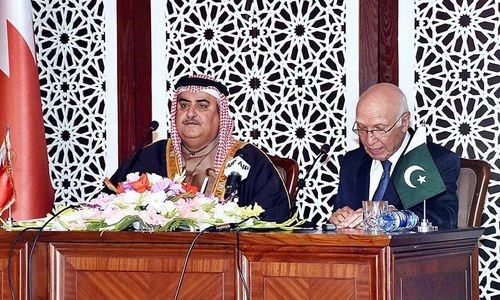
A high-powered delegation, led by Interim Commerce Minister Gohar Ejaz, held the final round of discussions with the GCC’s chief negotiator in Riyadh on Saturday. The goal was to finalise the investment segment of the FTA, a critical move preceding the GCC Foreign Ministers’ meeting in Doha on Sunday, where the FTA with Pakistan is expected to receive approval.
The agreed investment chapter is now set to be presented to the GCC ministers for approval, which was already included in the meeting’s agenda. The GCC Secretariat has the authority to sign the agreement on behalf of the six-member GCC countries. If approved, this will mark the first trade and investment agreement that the GCC has entered into with any country in the past 15 years.
The major decision among others will be the resolution of disputes locally within eight months before escalating them to the International Court of Arbitration. “Today, we have finalised the investment chapter of the FTA with the GCC team in Riyadh,” Mr Ejaz told Dawn via a telephone after the meeting.
Meeting of bloc’s FMs to approve FTA in Doha today
The minister said his team succeeded in creating a graduating approach by adding an eight-month period which will enable both investors for mutual settlement of disputes before going for arbitration to international courts.
In September, Pakistan agreed on the FTA with the GCC. However, the signing of the agreement was postponed as Saudi Arabia demanded to incorporate an investment chapter into the agreement. This chapter was particularly aimed at including a protection clause, specifically the provision of the forum of the International Centre for Settlement of Investment Disputes (ICSID).
In August 2004, Pakistan and the GCC, which includes Saudi Arabia, the United Arab Emirates, Bahrain, Oman, Qatar, and Kuwait, signed a framework agreement to explore the possibility of an FTA. However, only a handful of negotiation rounds occurred in the years that followed. The dialogue was revived in 2021 after a substantial hiatus.
In the previous year, both parties conducted technical-level discussions to assess the feasibility of finalising the agreement. This potential agreement could significantly enhance Pakistan’s export capacity to the GCC bloc.
Investment dispute
The former government of Pakistan Tehreek-i-Insaf introduced a new template for investment treaties, which only provides for local arbitration as a remedy. This template was introduced in response to the ICSID penalty of $6bn on Pakistan due to its refusal to grant a mining lease for the Reko Diq project to Australia’s Tethyan Copper Company.
Saudi Arabia, a major player in the GCC, was dissatisfied with this template and insisted on the specific inclusion of the ICSID for arbitration in the event of any dispute. The FTA and investment were tied to the provision of the ICSID, leaving Pakistan with no choice but to reverse its previous decision.
In a cabinet meeting presided over by Interim Prime Minister Anwaar ul Haq Kakkar, the investment template was revised to include three international arbitration bodies for dispute resolution: the ICSID, the Permanent Court of Arbitration, and the Dubai International Arbitration Centre. Following this amendment, the Pakistani delegation presented the updated investment chapter to the GCC negotiator.
Ahead of the cabinet approval, the executive committee of the Special Investment Facilitation Council (SIFC), a civil-military body working to bring foreign investment, has given the go-ahead for negotiating the investment chapter with Saudi Arabia by including the kingdom’s demand for international arbitration.
Mr Gohar stated that Pakistan already has international arbitration agreements, including the ICSID, with four other GCC countries. The newly introduced investment chapter will now apply to investments with Saudi Arabia and Qatar. He further clarified that the provisions of the investment chapter will apply to future investments with GCC countries.
Published in Dawn, December 3rd, 2023