Menstrual woes deepen agony for women in Gaza


THE situation in Gaza is deteriorating daily, and the most challenging struggles are being faced by women and children.
Women have no safe places to seek refuge, and the sanitary conditions are progressively worsening. According to Unicef’s most recent report, women are going through the worst menstruation crisis of the decade.
Due to the dire and unhygienic conditions in Gaza at present, many women have turned to using pills to postpone their menstrual cycles. Women in Gaza are confronting displacement and overcrowding, along with a shortage of access to water and menstrual hygiene items, the report says.
Women have started using norethisterone tablets, which are typically prescribed for conditions like painful periods, heavy menstrual bleeding, or endometriosis.
Dr Walid Abu Hatab, a medical consultant in obstetrics and gynaecology at the Nasser Medical Complex in Khan Yunis, explained to The Guardian that these tablets maintain elevated progesterone levels to prevent the uterus from shedding its lining, thus delaying menstruation.
Nevin Adnan, a psychologist and social worker based in Gaza City, notes that more women are considering the use of period-delaying pills to avoid embarrassment and shame due to an absence of hygiene, privacy and health products.
Nevertheless, these pills come with side effects, including irregular vaginal bleeding, nausea, alterations in menstrual cycle, dizziness and mood swings. Women in Gaza contend they had no choice but to take this risk due to the relentless genocidal campaign and blockade by the Israeli army.
“These war days are the toughest I’ve ever faced. I’ve had my period twice this month, which is highly unusual for me, and I’ve been dealing with heavy bleeding,” Salma Khaled, a 41-year-old who had to leave her home in the Tel Al Hawa neighbourhood and is currently seeking shelter with family, told Al Jazeera.
Lacking the means to manage her menstruation as she normally would, Salma decided to seek out pills to delay her period. While sanitary napkins are in high demand and difficult to find, period-delaying tablets are relatively more accessible in some pharmacies since they are not commonly used.
Physical and mental streess
Many displaced women in Gaza speak of the toll that the past three weeks have taken on their physical and mental well-being.
The displacement of hundreds of thousands of people has created immense stress for all residents in Gaza, and for women who are menstruating, or in the days leading up to or following their period, their symptoms get exacerbated.
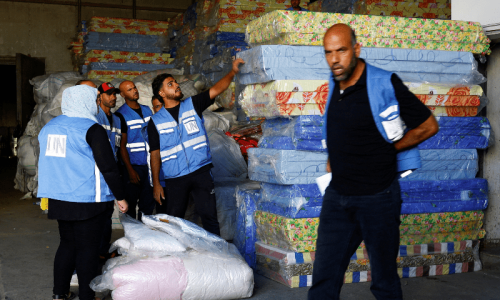
Pharmacies and stores are grappling with depleting supplies due to the complete blockade enforced by Israel after Oct 7.
Published in Dawn, November 4th, 2023