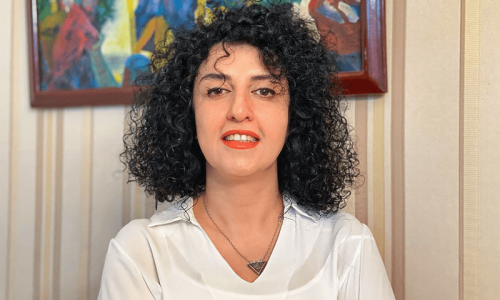
OSLO: “Victory is not easy, but it is certain,” imprisoned Nobel Peace Prize winner and women’s rights activist Narges Mohammadi, said in a message smuggled out of her Tehran cell and published late on Tuesday.
In the message, read out in French by her daughter, Kiana Rahmani, and posted on the official Nobel website, the 51-year-old activist and journalist expressed “sincere gratitude” to the Norwegian Nobel committee.
Mohammadi — who was awarded the prize in early October “for her fight against the oppression of women in Iran” — once again criticised the requirement for women in Iran to wear a headscarf, and denounced Iranian authorities.
“The compulsory hijab is a means of control and repression imposed on society and on which the continuation and survival of this authoritarian religious regime depends,” she declared through her 17-year-old daughter, who has taken refuge in France along with her family.
She condemned “a regime that has institutionalised deprivation and poverty in society for 45 years”, adding that it was “built on lies, deception, cunning, and intimidation”.
Arrested 13 times, sentenced five times to a total of 31 years in prison and 154 lashes, and imprisoned again since 2021, Narges Mohammadi is one of the women spearheading the “Woman, Life, Freedom” uprising in Iran.
The movement, which has seen women take off their headdresses, cut their hair and demonstrate in the streets, was sparked by the death of a young 22-year-old Iranian Kurdish woman, Mahsa Amini, last year after she was arrested in Tehran for failing to comply with the strict Islamic dress code.
On Saturday, Armita Garawand, a 17-year-old ethnic Kurd, died a week after she was declared “brain dead”. She had been hospitalised since Oct 1 after falling unconscious on the metro.
Rights groups have said the teen was critically wounded during an alleged assault by female members of Iran’s morality police. The authorities dispute this account, saying she suddenly fell ill.
“We, the people of Iran, demand democracy, freedom, human rights, and equality, and the Islamic Republic is the main obstacle in the way of realising these national demands,” Mohammadi said in her message.
“We… are struggling to transition away from this religious authoritarian regime through solidarity and drawing on the power of a non-violent and unstoppable process in order to revive the honour and pride of Iran and human dignity and prestige for its people,” she said.
Published in Dawn, November 2nd, 2023