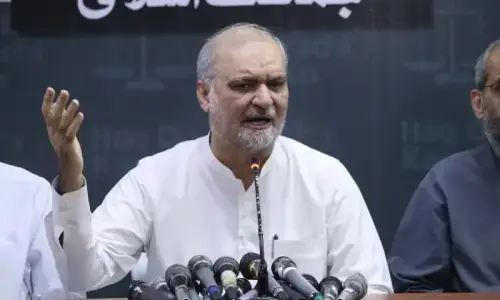
PESHAWAR, Feb 8: Mehmood Khan Achakzai, president of the Pakhtoonkhwa Milli Awami Party (PMAP) is reported to be aganst merging his party into the Awami National Party (ANP) because of difference on a number of issues.
Sources close to Mr Achakzai told Dawn that ANP president Asfandyar Wali Khan had initiated a drive to unite all Pukhtoon nationalist parties under the umbrella of the ANP. He has, so far, been successful in bringing back nationalist leaders such as Ajmal Khattak, Abdul Lateef Afridi and Afrasiab Khattak into the ANP fold. Afzal Khan recently announced the merger of the PQP with ANP on Feb 6.
The sources said that Mr Asfandyar discussed the issue of PMAP’s merger with the ANP and he planned to visit Quetta to persuade Mr Achakzai and other party leaders to join the ANP. Mr Asfandyar said that he was doing it to realize his father’s dream of Pukhtoon unity.
The sources said that the PMAP leaders believed that political differences between the two parties dimmed the possibility of a merger. Different stances on issues like party membership, geographical boundaries of the Pukhtoonkhwa province and its name, different opinions about the 1973 Constitution and administrative control over the Federally-Administered Tribal Areas and the 1991 water accord were hurdles which obstructed the two parties’ merger.
He said that the ANP’s membership was open to people of all nationalities and communities but PMAP’s membership was restricted to Pukhtoons. He said that the PMAP supported alliance with any other nationalist party but did not favour merger with multi-nationality parties like the ANP.
He said that the ANP was striving to revive the 1973 constitution in its original form, while the PMAP termed it a ‘dead document’ and called for a new constituent assembly based on equal rights to Pukhtoon, Baloch, Sindhi, Saraiki and Punjabi peoples.
He said the PMAP contended that the 1973 Constitution had denied an entity to the Pukhtoon nationality by dividing its rights in four parts of the federation.
ANP demanded Fata’s administrative control under the provincial government, while PMAP desired an independent entity for the tribal territories with its own governor and other decision making powers assigned to the tribesmen.
Differences also exist between the two parties over the 1991 water accord. The ANP was a signatory to the document while the PMAP had denounced the accord saying that waters of the Indus River belonged to Pukhtoon, Sariaki and Baloch people and that it was unfair to assign 48 per cent of its water to Punjab.