DUBAI: Israel and Saudi Arabia have agreed to the outline of a historic US-brokered deal to normalise relations, the White House said on Friday, amid reports that the pact would be devoid of “iron-clad defence guarantees” and major concessions to Palestinians in their bid for statehood.
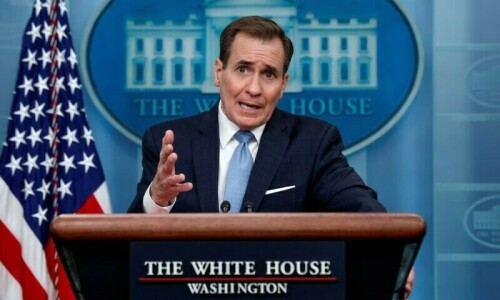
White House National Security Council spokesman John Kirby told reporters that the “basic framework” of the deal has been “hammered out”.
“But, as in any complex arrangement, as this will inevitably be, everybody is going to have to do something. And everybody is going to have to compromise on some things.”
Three regional sources familiar with the talks told Reuters the pact might fall short of the cast-iron, Nato-style defence guarantees the kingdom initially sought.
Kingdom won’t get Nato-style defence guarantees from US; congressional approval remains challenge for Biden
The deal could look like treaties Washington has with Asian states or, if that would not win US Congress approval, it could be similar to a US agreement with Bahrain, where the US Navy Fifth Fleet is based, a US source said. Such an agreement would not need congressional backing.
Washington could also sweeten any deal by designating Saudi Arabia a major non-Nato ally, a status already given to Israel, the US source said.
‘Some concessions’ for Palestinians
The Palestinians could get some Israeli restrictions eased but such moves would fall short of their aspirations for a state. As with other Arab-Israeli deals forged over the decades, the Palestinian core demand for statehood would take a back seat, the three regional sources familiar with the talks said.
“The normalisation will be between Israel and Saudi Arabia. If the Palestinians oppose it the kingdom will continue in its path,” said one of the regional sources.
“Saudi Arabia supports a peace plan for the Palestinians, but this time it wanted something for Saudi Arabia, not just for the Palestinians.”
Diplomats and the regional sources said Crown Prince Mohammed bin Salman was insisting on some commitments from Israel to show he was not abandoning the Palestinians and that he was seeking to keep the door open to a two-state solution.
Those would include demanding Israel transfer some Israeli-controlled territory in the West Bank to the Palestinian Authority (PA), limit Jewish settlement activity and halt any steps to annex parts of the West Bank. Riyadh has also promised financial aid to the PA, the diplomats and sources said.
While the Saudi government and the US State Department did not respond to emailed questions about this article.
‘Less than a full treaty’
A US official said the parameters of a defence pact were still being worked out.
The official added that what was being discussed “would not be a treaty alliance or anything like that … It would be a mutual defence understanding, less than a full treaty.”
A source in Washington familiar with the discussions said MbS had asked for a Nato-style treaty but said Washington was reluctant to go as far as Nato’s Article 5 commitment that an attack on one ally is considered an attack on all.
But all the sources said Saudi Arabia would not settle for less than binding assurances of US protection if it faced an attack.
A template, which would not need congressional approval, would be the agreement signed with Bahrain on Sept 13, in which the US pledged to “deter and confront any external aggression” but also said the two governments would consult to determine what, if any, action would be taken.
Congressional challenge
Even if the US, Israel and Saudi Arabia agree, winning support from lawmakers in the US Congress remains a challenge.
Republicans and those in Biden’s Democratic Party have previously denounced Riyadh for its military intervention in Yemen, its moves to prop up oil prices and its role in the 2018 killing of Saudi journalist Jamal Khashoggi.
“What’s important for Saudi Arabia is for Biden to have the pact approved by Congress,” the first regional source said.
Published in Dawn, October 1st, 2023