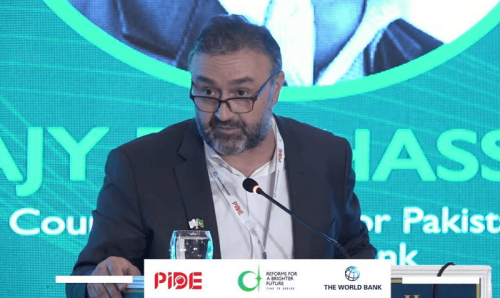
ISLAMABAD: Highlighting ‘incomplete devolution’ and institutional weaknesses as key development and governance challenges and pinning little hopes on technocratic government, the World Bank has advised Pakistan to create a ‘National Council of Ministers’ — comprising key federal and provincial representatives — to fill the vacuum for simultaneous and coordinated strengthening of poorly performing federal and provincial institutions, policies and accountability systems.
“While technocratic interventions are unlikely to transform Pakistan’s institutional environment in the short term, the current contextual factors — deteriorating economic conditions, demographic change and social media — may present some windows of opportunity for positive change,” said the Washington-based lending agency in policy advice.
It said Pakistan did not effectively implement devolution initiated through the 18th Amendment and the Centre continued to deliver many devolved functions, creating overlaps in service delivery, increasing fiscal costs, and blurring accountabilities. Thus, prevailing fiscal arrangements weaken accountability for revenue collection and complicate tax administration. “Performance reviews are rare and incentives reward adherence to the rules rather than good operational performance” and promotions are made on seniority and informal networks, rather than qualifications.
To address such obstacles, the World Bank has asked the government to take “immediate measures” to improve coordination between different layers of and provincial governments.
Points to flawed devolution and institutional weaknesses as key governance challenges
It said that since the decisions made by the Economic Coordination Committee or the federal cabinet are no longer binding on the provinces, the Council of Common Interests (CCI) and the National Economic Council (NEC) should play a critical role in supporting national policy coordination and coherence.
“A National Council of Ministers, consisting of the federal and provincial ministers working under the aegis of the council for Common Interests (CCI) should formulate and monitor the implementation of key national policies, including in education, health, food security and agriculture, water and sanitation, and transport,” it said.
The bank said the newly elected government should immediately begin to build consensus around technical implementation arrangements for a decentralised system, including expenditure cuts, tax and revenue assignments as well as transfer of functions and tax instruments.
An appropriate constitutional body (likely CCI) should develop an implementation plan based on the agreed vision, through a consultative process with broad provisions.
This plan should provide a clear and mutually agreed division of responsibilities between the federal, provincial and local governments, arrangements for tax devolution, grants, and subnational revenue collection to ensure that each level of government has adequate resources to finance its respective cities, based on costing of service delivery responsibilities and assessment of revenue potential as each level, and necessitating revisions to the 7th NFC award.
Federal-provincial fiscal coordination
In parallel, federal-provincial fiscal coordination should be improved including further efforts to harmonise tax policy and administration and ensure the effective implementation of a national medium-term fiscal framework, in line with new federal and provincial fiscal responsibility legislation.
It said a series of measures should be prioritised to strengthen institutions and support implementation that helps strengthen accountability and counteract elite capture while building the administrative capacity of government to deliver critical reforms and investments. This will have important impacts on private sector confidence and investment, by improving the quality of public services, addressing policy instability and corruption, and better aligning policies with the interests of citizens and firms.
The bank called for improving processes for public sector appointment, performance management, and tenure as implementation of public sector reforms was being impeded by the vested interests of senior bureaucrats in maintaining the status quo.
For this, strong political leadership will be required to change incentive structures within the public service through the introduction of a Performance Management System (PMS) across the public sector, under which public servants be assessed against the achievement of agreed performance indicators, with performance assessment feeding into career progression, salary increases, and in cases of persistent poor perform early retirement.
Also, the security of tenure should be strengthened for all government officers and any decision to remove a government officer from the position before the end of an appointment term should require a written justification, with the affected person provided the right to challenge this decision through an independent, formal process.
The processes for the open, competitive appointment of chief executives to public sector agencies with critical economic and social functions (including PIA, WAPDA, PSO, and Pakistan Railways) should be strengthened and maintained and their appointments be safeguarded from political interference.
The chief executives be provided with operational autonomy and a fixed tenure and held accountable for results against a set of clearly defined objectives and goals.
Moreover, in-service training of government officers should be strengthened to close important skills gaps, while recruitment should be recalibrated to focus on key relevant skills and expertise, rather than strong performance against the public service exam.
On top of that, digitalisation should be pursued to increase efficiency and reduce opportunities for corruption as Pakistan already has a conducive environment with significant penetration of smart mobile phones, many electronic databases, computerised land records, automated banking apps, a vast fibre optic network, and a burgeoning IT industry.
This provides a ready system of electronic platforms and e-service centres to provide a single platform for all forms, clearances, NOCs, and seeking rulings.
Published in Dawn, September 25th, 2023