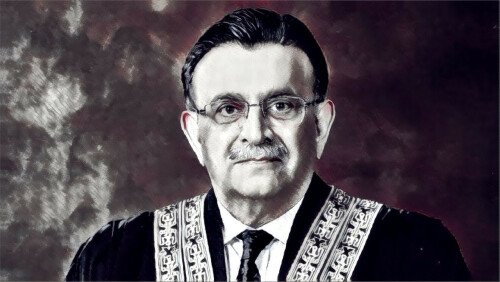
IN a ceremony marked by constitutional gravitas as well as what some might term rightful vindication, Justice Qazi Faez Isa assumed the mantle of the chief justice of Pakistan on Sunday, heralding what the nation hopes will be a period of judicial prudence and wisdom.
The optics of the event were rich with irony, with the president, who had previously filed a reference against the Supreme Court judge over alleged misconduct and non-disclosure of assets, himself administering the oath.
With the new chief justice’s spouse standing by his side, it was a symbolic moment that sent “a clear message of steadfastness”, as put by one participant.
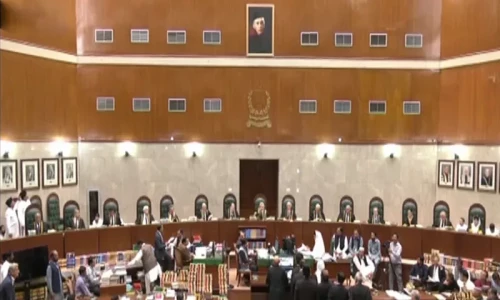
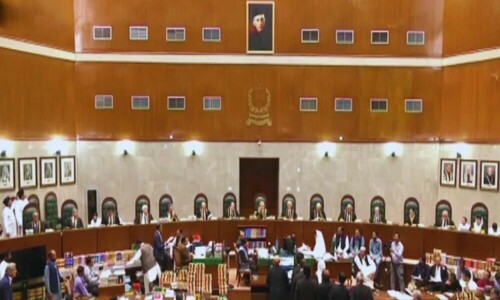
The new chief justice jumped right into action and constituted a full court to preside over his inaugural hearing as chief justice, one that aims to resolve nine challenges to a law that, among other things, requires the formation of benches on constitutional matters of public importance by a committee of three senior Supreme Court judges.
In a first for the country, he also ordered the proceedings to be broadcast live to the public. The constitution of a full court — a rarity in the court of the previous Supreme Court chief justice — and the live telecast of the hearing, can be viewed as a promising start, a sign that Chief Justice Isa is keen to chart a path firmly rooted in jurisprudential integrity rather than the shifting sands of populism that marred his predecessor’s tenure.
Former chief justice Umar Ata Bandial was at one point lambasted by fellow members of the judiciary for having begun to run a “one-man” show, and so his time in office saw more controversy than judicious stewardship of the nation’s highest legal office.
Justice Isa takes charge at a time when the judiciary faces a myriad of challenges, from more than 50,000 cases pending before the apex court out of some 2.2m to be decided overall, to the critical task of restoring the public’s confidence in the justice system.
Moreover, there is the ever-looming test of safeguarding the judiciary’s independence in the face of executive incursions.
Some of the more pressing concerns, however, include the delay in general elections, the trial of civilians in military court, and pending references against the chief justice’s colleague Justice Mazahar Ali Akbar Naqvi.
It is precisely these challenges that lend the new chief justice the opportunity to carve out a legacy of robust judicial leadership, guided by a moral compass that remains unswayed by the tempestuous winds of political expedience.
As he embarks on this pivotal journey, we hold out measured, but optimistic hope that under his leadership, the top court will not only adjudicate, but guide the nation towards a path paved with justice, equality and the rule of law.
Published in Dawn, September 19th, 2023