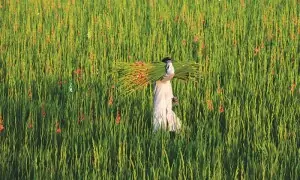
LOWER DIR: Experts have asked farmers to voluntarily remove a fast growing unwanted weed from their fields due to its harmful effects on human health.
“Parthenium plant, locally known as Gajar Booti, has occupied roadsides from Adenzai to Dir Khas,” Arifullah, a social mobiliser, told this scribe in Talash. He said that according to a research, the plant was brought to Pakistan and India from Mexico, Central and South American states.
The social activist said that due to the invasive nature of the plant, it spread rapidly all over the country from the roadsides to the farms and parks.
Mr Arif, also a staff member of a government organisation working in Lower Dir, said that he along with other social activists had taken the matter seriously and started uprooting it on roadsides and boundaries of fields.
He, however, said that the task could not be completed simply by individuals as it needed public support. He said that currently the plant was seen on the roadsides but it would soon take over farmlands if not uprooted totally.
Habibul Haq, an agriculturist, said that agriculture department launched several campaigns to combat Parthenium. He said that people, especially farmers, should be made aware of its harms to crops, livestock and human beings.
He said that Parthenium weed could cause asthma, eye irritation, allergies and chest and throat infections. He said that one plant of Parthenium could produce thousands of seeds, which spread easily through air and water due to its light weight.
The expert said that the plant grew rapidly in Lower Dir during the month of April to November. He said that on rainy days it grew up to 1.5 metre long. He said that Parthenium like other invasive plants posed a serious threat to biodiversity and agriculture. He added that an organised and planned movement was needed to combat that dangerous species.
Tariq Saeed, a veterinary doctor, said that Parthenium was a toxic plant that caused bitter milk diseases in livestock when cattle consumed it with fodder. He said that the plant would become more dangerous if it was not uprooted.
Published in Dawn, September 19th, 2023