Full court to take up law limiting CJP’s powers today


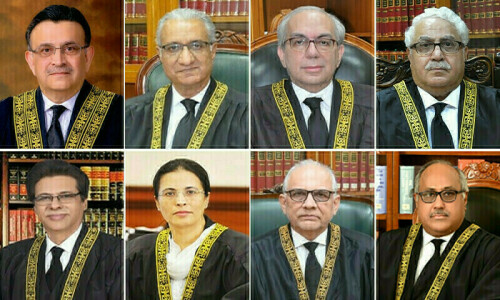
ISLAMABAD: Chief Justice of Pakistan (CJP) Qazi Faez Isa has constituted the full court comprising all 15 judges of the Supreme Court to take up on Monday (today) a set of nine challenges to the Supreme Court (Practice and Procedure) Act 2023 — a bill that required formation of benches on constitutional matters of public importance by a committee of three senior judges of the court.
Headed by CJP Qazi Faez Isa, the bench will consist of Justice Sardar Tariq Masood, Justice Ijazul Ahsan, Justice Syed Mansoor Ali Shah, Justice Munib Akhtar, Justice Yahya Afridi, Justice Aminuddin Khan, Justice Sayyed Mazahar Ali Akbar Naqvi, Justice Jamal Khan Mandokhel, Justice Muhammad Ali Mazhar, Justice Ayesha A. Malik, Justice Athar Minallah, Justice Syed Hasan Azhar Rizvi, Justice Shahid Waheed and Justice Musarrat Hilali.
The previous government of PDM had enacted the Supreme Court (Practice and Procedure) Bill 2023, aimed at limiting the powers of the top judge.
The legislation deprives the office of the CJP of powers to take suo motu notice in an individual capacity.
The law states that a three-member bench, comprising the CJP and the two senior-most judges of the apex court, will decide whether or not to take up a matter suo motu. Previously, this was solely the prerogative of the CJP.
Additionally, it adds to the review jurisdiction of Supreme Court, giving the right to file an appeal within 30 days of the judgement in suo motu cases.
On April 13, an eight-judge SC bench headed by former CJP Umar Ata Bandial, had suspended the enforcement of the Supreme Court (Practice & Procedure) Act, 2023.
It is expected that the court proceedings may be streamed live.
Earlier on March 24, 2022, Justice Munib Akhtar described an application of Justice Isa for public broadcast and live court coverage of his review petition as novel and ordered the matter to be referred to the CJP for deliberation and appropriate action by the full court.
The matter was referred in view of the evolving practice of courts around the world and acknowledging the benefits of technology for the justice system, Justice Akhtar had observed in a judgement he authored.
On April 13, 2021, the Supreme Court by a majority of six to four dismissed Justice Isa’s application seeking permission for live streaming of the hearing of his review petitions.
Justice Akhtar observed that technological developments should be monitored and appreciated, to ensure that access to justice for litigants was constantly improving.
Therefore, the court’s dismissal of the application should not be construed as an absolute refusal of public broadcast or live streaming of the court proceedings. Instead, it should be understood as an exercise in judicial restraint and caution.
About the practice and procedure law, Justice Isa in a statement on behalf of the government-appointed audio leaks commission had told the Supreme Court hearing a set of six challenges to the probe body that the bench hearing the matter was not determined by a three-man committee of judges as required under the Supreme Court (Practice and Procedure) Act 2023.
In its reply, the commission had highlighted that the Supreme Court (Practice and Procedure) Act 2023 required that every appeal or case before the apex court should be heard by a bench constituted by the committee of judges comprising CJP and two most senior judges.
Since the petitions challenging the audio commission were not fixed before the bench constituted by the committee of judges, therefore these petitions cannot be heard till the committee determines which bench should hear them, the commission had stated.
Earlier on June 3 also, Justice Isa had decided not to sit on a nine-judge bench hearing cases on the trial of civilians by the military courts saying he did not want to violate the suspension of law and until the court decides about the vires of the law (practice and procedure) he will not sit on the benches.
Then Justice Isa had also regretted that the outgoing CJP Umar Ata Bandial had put other judges of this court into unnecessary quandary. As a result, Justice Isa chose to do chamber work for many months instead of holding court hearings.
Published in Dawn, September 18th, 2023