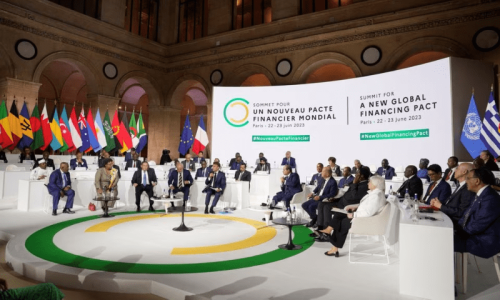
The International Monetary Fund (IMF) and World Bank on Thursday issued a rare joint statement pledging to step up their cooperation to address climate change, debt vulnerabilities and countries’ digital transitions.
The statement, released ahead of a G20 leaders summit in India this week, said the two institutions can help address mounting challenges facing the global economy — from increasing climate disasters to slowing growth and geopolitical fragmentation — by working together.
“The Bretton Woods institutions, with their universal membership and specialist expertise, are well-placed to make a critical contribution to help countries tackle these challenges,” IMF Managing Director Kristalina Georgieva and World Bank President Ajay Banga said in the joint statement.
The IMF and World Bank were established in 1944 at a meeting in Bretton Woods, New Hampshire.
Banga is scheduled to attend his first G20 summit after starting as the World Bank’s new president in June, with a mandate to expand the lender’s resources to help tackle climate change, pandemics, fragility and other global crises alongside its traditional anti-poverty mission.
US President Joe Biden at the G20 summit intends to focus heavily on reforming the World Bank and other multilateral development lenders to scale up their lending for climate and infrastructure.
The US sees the institution as an important counterbalance to China’s overseas lending.
The joint IMF-World Bank statement said the two institutions would collaborate on climate change on a more structured and institutionalised footing.
This includes formalising regular meetings of the new Bank-Fund Climate Advisory Group every two months to consider climate-related developments on key projects, including loans through the IMF’s new Resilience and Sustainability Trust, which provides middle-income countries with financing on climate resilience and transition projects.
Debt vulnerabilities
The two institutions also said they will incorporate climate considerations into their work on debt sustainability for low-income countries.
The IMF and World Bank have worked closely on debt sustainability issues, both pushing for improved restructuring frameworks. They launched a sovereign debt roundtable last year to standardise restructuring concepts and speed up debt treatments.
“We will enhance our joint work to help prevent further build-up of debt vulnerabilities, assisting countries to strengthen debt management and transparency and public finances,” Georgieva and Banga said, adding that they would also deepen support to creditors and debtors engaged in debt restructurings.
On the digital transition, the two institutions said they would collaborate to help countries to connect their citizens to online services and reduce barriers to digital inclusion.
“We will step up our joint work to help countries increase the effectiveness of revenue collection and expenditure systems and reap the benefits of new digital technologies while mitigating the risks,” Georgieva and Banga said.
That will include improving cross-border payment systems while ensuring that such innovations spur growth, poverty reduction and job creation, they added.