0
0

LAHORE, Feb 4; The Pakistan Law and Justice Commission (PLJC) has recommended holding of immediate judicial inquiry by additional district and sessions judge in case of suicide or death of any jail inmate and allowing detained foreigners to meet the staff from their missions and arrangements for their repatriation on completion of their sentence.
Foreigners involved in minor offences be deported to their country of origin. Payment of adequate amount to prisoners for travel to their homes on release and informing their relatives about their release in advance was also recommended.
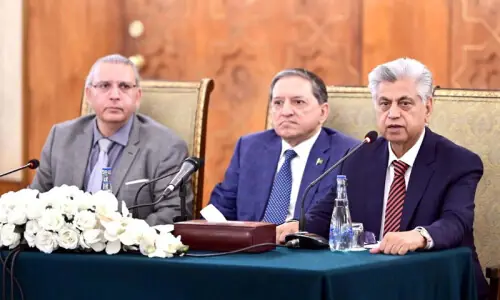
The commission which met held here with Chief Justice of Pakistan Justice Iftikhar Muhammad Chaudhry in chair, recommended allowing the condemned prisoners a one hour walk in morning and evening and restriction of handcuffs during walk only to terrorists and dangerous criminals. Installation of security systems like cameras and other gadgets was also stressed for preventing escape of prisoners.
It further recommended:
— arrangements for the accommodation, food, education and recreation of children, accompanying convict women.
— review of the system of granting remission on account of acquiring education and higher qualifications with a view to allow remission on the basis of certificate/degree awarded. For higher degrees the period of remission should be greater. — arrangements for provision of legal aid to indigent prisoners and to facilitate prisoners in meeting their counsel and allowing the children to meet their relations in prisons and the prisoners not involved in heinous offences and having good character to join their families for two to three days after each four months.
— improvement of facilities in prisons (food, clothing, medical, sanitation and education) etc., regular official visits to the prisons in every three months by the IGP alongwith district nazim, district & sessions judge and director of health services, adequate facilities in death cell, rationalisation of remission system for the benefit of prisoners with good conduct.
— lodging of convicts in jails near their native places and avoiding housing of political prisoners with criminals. Mentally ill patients should also be housed separately. Extension of time for filing appeals against death sentence from seven days to one month and to 60 days in case of life imprisonment and improvement of conditions at judicial lockups.
—- need for determining the number of prisoners in death cell in accordance with its capacity. Need for proper utilisation of Badin open jail and establishment of more open jails at other places.
— encouraging private sector to set up industries in jails and pay adequate wages to prisoners. Arrangements for education and medical care of prisoners.
— strengthening the system of jail inspection so that the judges of high courts and subordinate courts regularly visit jails and give on-the-spot instructions regarding the cases of under-trial prisoners. Prisoners with good conduct may also be released on short parole to meet their families and help them in tasks such as cultivation/harvesting of crops, etc.
— steps to eradicate corruption in jails.
— release of a greater number of prisoners on parole not just for working as domestic servants but also to be employed in trade, industry and other commercial institutions in the public/private sector. Women and indigent prisoners confined in jail and unable to arrange the payment of fine or compensation should be released through contribution/assistance provided by volunteer associations, philanthropists/NGOs.
— establishment of more courts for ensuring speedy disposal of cases and checking overcrowding in jails. Prison officials, guilty of illegal detention of prisoners and their detention after completion of sentences should be punished. Jail staff disobeying court orders with regard to right and welfare of prisoners be taken to task.
— dealing with the cases of juvenile offenders in accordance with the provisions of Juvenile Justice System Ordinance, 2000 and keeping them in congenial environment in borstals. The government should provide free legal aid to defend the cases of children and women who have no means to defend themselves. Female Juvenile offenders be housed in separate enclosures of the borstal institutions. The police should strictly adhere to the statutory provisions regarding detention of the accused. Sexual harassment and physical torture of children which are common in lock-ups be eliminated through disciplinary proceedings against the officials involved in such acts.
ENHANCING PENALTIES IN PROVINCIAL STATUTES: The commission also considered enhancing punishments of fines in various statutes of the provinces of Balochistan, NWFP, Punjab and Sindh which were fixed long ago. Some were revised but most have remained unchanged. Due to the passage of time and devaluation of currency, the fines have seemingly lost their impact and are no longer serving the purpose of deterrence. Therefore, the commission approved that these fines be enhanced as per following formula: (1) Statutes enacted from 1851 to 1900: five fold increase in amount of fine (2) Statutes enacted from 1900 to 1950: four fold increase in amount of fine (3) Statutes enacted from 1950 to 1975: three fold increase in amount of fine (4) Statutes enacted from 1975 to 1995: two fold increase in amount of fine.
The commission also examined the issue of maintenance and cost of living to the divorced women having a suckling baby to be provided by her ex-husband, father of the baby, as ordained in the Holy Quran. It observed that a divorced woman with a suckling of below two years has a right to seek cost of living during the suckling period. It unanimously approved that the Muslim Family Laws Ordinance of 1961 and the Family Courts Act of 1964 may be amended to provide maintenance and cost of living to the divorced woman during suckling period of the baby.
REPEAL OF JUDICIAL OFFICERS PROTECTION ACT; The commission also considered the protection provided to judges, magistrates and collectors from civil liability of their acts causing a civil wrong during discharge of their duties under the Judicial Officers Protection Act 1850 and approved its repeal in line with abolition of such protection availed to a judge, magistrate and public servants from criminal liability unless such act has a nexus with their official duties as directed by the Shariat Appellate Bench of Supreme Court while declaring Section 197 of the Criminal Procedure Code and Section 75, Criminal Law Amendment Act 1958 for their prosecution of an offence committed during the discharge of their duties. The proposed repeal will make the judicial officer more conscious to act.
FATAL ACCIDENT ACT; The commission also examined the Fatal Accidents Act 1855, providing right to seek damages to the heir of the victim. The law was enacted when there was no law of Diyat. The offence of qatl-i-khata committed by fatal accident is liable to Diyat under the Pakistan Penal Code which is a form of compensation to the heirs of the victim, therefore, the provisions of Fatal Accident Act 1855 came in conflict with the Pakistan Penal Code. The commission, therefore, recommended the repeal of Fatal Accident Act 1855.
Repeal of Kazis Act 1880, Sarais Act 1867 & Recusant Witnesses Act 1853: The commission said these laws have exhausted their utility and have become dormant in application as with the passage of time new laws regulating in the evidence of witnesses, hotel and restaurant industry and registration of marriages etc heave been enforced.
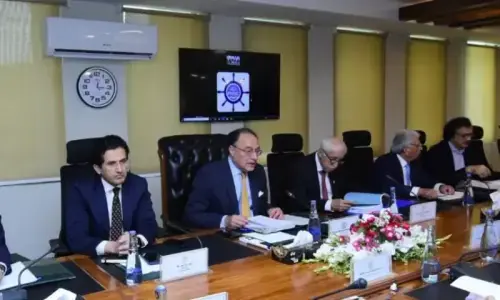
The meeting was attended besides other members of the commission, Mr Makhdoom Ali Khan, Attorney General of Pakistan, Mr Justice Ch Ejaz Yousaf, Chief Justice, Federal Shariat Court, Mr Justice Iftikhar Husain Chaudhry, Chief Justice, Lahore High Court, Mr Justice Sabihuddin Ahmed, Chief Justice, Sindh High Court, Mr Justice Tariq Parvez, Chief Justice, Peshawar High Court, Mr Justice Amanullah Khan, Chief Justice, Balochistan High Court, Mr Justice (retired) Qazi Muhammad Farooq, Mr Justice (retired) Amirul Mulk Mengal, Mr Justice (retd) Mansoor Ahmed, Secretary, Ministry of Law & Justice, Dr Arfa Sayeda Zehra, chairperson, National Commission on Status of Women, Mrs Nasira Iqbal & Mr Abdul Qadir Halepota, advocates and Dr Faqir Hussain, Secretary, Law & Justice Commission.
The chief justice also presided over the meeting of the National Judicial Policy Making Committee which considered the difficulties being faced by women or children decree holders in getting execution of decrees of the family courts in filing separate application for execution of decree. The decree holders have to bear further cost of fee of the counsel, process fee of service/substituted service etc. The NJPMC resolved that the act may be amended in line with Financial Institution (Recovery of Loans and Finances) Ordinance 2001 and as soon the decree is passed by the family court the plaint shall be automatically converted in execution proceedings without requiring separate application or a fresh notice to the judgment debtor and the court may after a period of 30 days order for execution of decree.
The committee also considered the violations Child Marriage and Restraint Act 1929 and recommended measures for effective implementation of the act by making the public aware of restraint of child marriage provided in the law. The union council or the authority where there is no union council, may be issued directions to make complaints on violation of law to the competent court. The nikah registrars may verify the marriageable age of the parties from school leaving certificate, or national identity card, or Nadra B form, or passport, or birth certificate before solemnizing nikah of the parties.
Governing body, access to Justice Development; The CJP also chaired the meeting of the governing body of Access to Justice Development Fund and attended by LHC CJ Mr Justice Iftikhar Husain Chaudhry, SHC CJ Mr Justice Sabihuddin Ahmed, PHC CJ Mr Justice Tariq Parvez, BHC CJ Mr Justice Amanullah Khan, Mr. Justice (retd) Mansoor Ahmed, Secretary, Ministry of Law & Justice, Dr Faqir Hussain, Secretary, Law, Justice Commission and Additional Secretary (Finance). The meeting of the National Judicial Policy Making Committee was attended by other members of the Committee, namely, Mr. Justice Ch. Ejaz Yousaf, Chief Justice, Federal Shariat Court, Mr. Justice Iftikhar Husain Chaudhry, Chief Justice, Lahore High Court, Mr. Justice Sabihuddin Ahmed, Chief Justice, High Court of Sindh, Mr. Justice Tariq Parvez, Chief Justice, Peshawar High Court, Mr. Justice Amanullah Khan, Chief Justice, High Court of Balochistan, and Dr Faqir Hussain, Secretary, Law & Justice Commission.