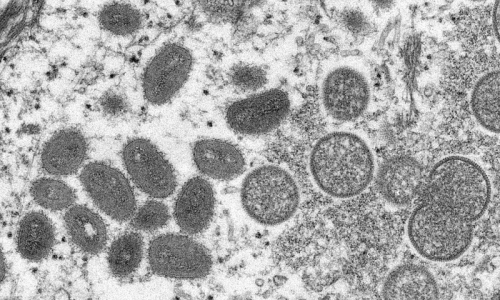
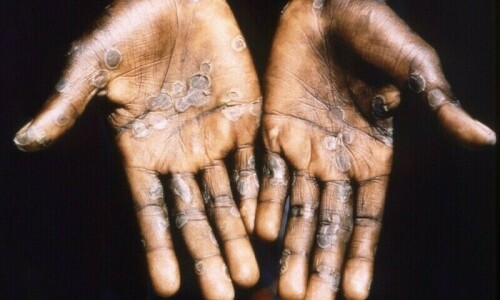
RAWALPINDI: Though the National Institute of Health (NIH) on Sunday confirmed a monkeypox patient in the garrison city, doctors at the Holy Family Hospital (HFH) decided to reconfirm it as the patient had a history of darier skin disease, which shows similar symptoms.
A 28-year-old male patient arrived from Gujar Khan on Friday with skin rashes and other symptoms related to monkey pox. He had earlier visited Saudi Arabia and returned last week after spending some time there.
After arrival in the hospital, the doctors took samples and sent it to the NIH and informed the District Health Authority about the suspected patient.
Holy Family Hospital head of infectious diseases Dr Mujeeb Khan told Dawn that the patient arrived in the hospital with symptoms of monkeypox. It was also found that he had been getting treatment for darier disease from a well-known skin specialist on Peshawar Road for the last eight to 10 years.
He said doctors sent samples to NIH which confirmed on Sunday that the patient was suffering from the infectious disease of mpox.
“As the patient informed the doctors about his skin disease later, it was decided to reconfirm it from the NIH and his blood and other samples will be sent to NIH again on Monday,” he said.
However, he said that the HFH administration kept the patient in quarantine to avoid spread of the disease. He said doctors and staff of the hospital were adopting standard operating procedures issued by World Health Organisation (WHO) for the infectious diseases, including mpox.
He said the district administration and the District Health Authority had already been informed about the details of the patient for surveillance and to trace his near contacts in case the NIH again declares it as a mpox patient.
He said that the condition of the patient was stable and he was being given treatment against infectious disease as there was no specific treatment for mpox.
Dr Khan said darier disease was a skin condition characterised by wart-like blemishes on the body. The blemishes are usually yellowish in colour, mildly greasy and can emit a strong odour. The most common sites for blemishes are the scalp, forehead, upper arms, chest, back, knees, elbows and behind the ear.
Meanwhile, a team from the NIH is conducting epidemiological investigations and contact tracing. His relatives are also being monitored.
The NIH said there is no risk of further spread of the disease in Pakistan for the time being.
With the latest case, the number of people affected with the disease has reached four in Pakistan. The third case of mpox was reported in May in Mandi Bahauddin in a foreign-returned passenger.
The NIH confirmed that the infected person returned to Pakistan from abroad and had a check-up due to deterioration of his health. The first two cases of the disease were also from Punjab.
Published in Dawn, August 21st, 2023