Nato welcomes Ukraine, but stops short of invitation


 0
0
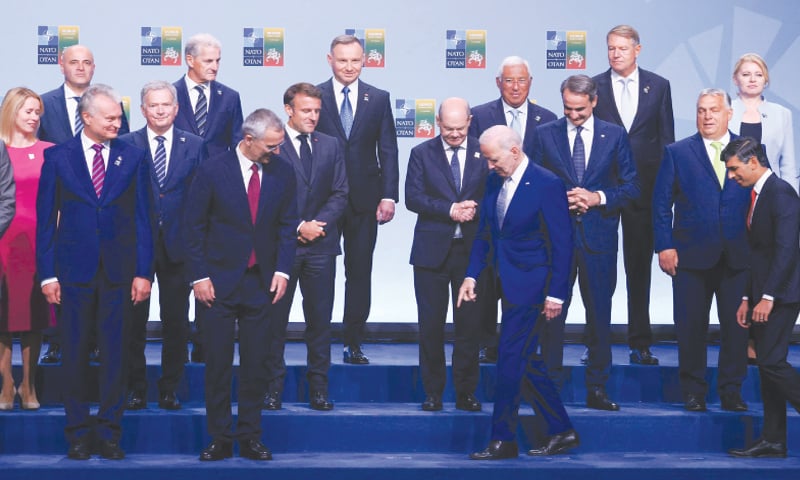
VILNIUS: Nato leaders agreed on Tuesday that Ukraine’s future lies within the alliance but they stopped short of handing Kyiv the invitation or timetable for accession it sought, a stance that Ukrainian President Volodymyr Zelensky had earlier criticised as “absurd”.
The leaders met at a summit in the Lithuanian capital Vilnius as a Ukrainian counteroffensive against the Russian invasion forces occupying parts of the country was proceeding more slowly than Kyiv had hoped.
In its declaration, Nato also dropped the requirement for Ukraine to fulfil what is called a Membership Action Plan (MAP), effectively removing a hurdle on Kyiv’s way into the alliance.
“Ukraine’s future is in Nato,” the declaration said. “We will be in a position to extend an invitation to Ukraine to join the alliance when allies agree and conditions are met.” They did not specify the conditions Ukraine needs to meet, but they said the alliance would help Kyiv to make progress on military interoperability as well as on additional democratic and security sector reforms.
Zelensky says Ukraine will make bloc stronger; key requirement dropped to remove hurdles to Kyiv’s path into alliance
‘Positive message’
“Nato will make Ukraine safer, Ukraine will make Nato stronger”, Zelensky told a crowd in central Vilnius, adding that the military alliance would make his country safer and it deserved to be allowed to join.
Zelensky had earlier assailed Nato leaders for not offering a timeframe for membership.
“It’s unprecedented and absurd when a timeframe is not set, neither for the invitation nor for Ukraine’s membership,” Zelensky said before arriving as a special guest.
Zelensky ‘s salvo at the start of a summit came after Nato chief Jens Stoltenberg said the bloc would send Kyiv a “positive message” on its path to membership.
It highlighted the divisions among Nato’s 31 members over giving a date or a straightforward invitation for Ukraine to join. Kyiv has been pushing for a swift entry, bound together with security guarantees, since even before Russia unleashed its invasion in February 2022.
The declaration said: “We reaffirm our unwavering solidarity with the government and people of Ukraine in the heroic defence of their nation, their land, and our shared values.” In strong language towards Moscow, it said: “The Russian Federation is the most significant and direct threat to Allies security and to peace and stability in the Euro-Atlantic area.” Asked about Zelensky’s criticism, Stoltenberg told a press conference: “There has never been a stronger message from Nato at any time, both when it comes to the political message of the path forward for membership and the concrete support from Nato allies.” He said previous accessions to Nato had not been accompanied by a timeline. “They are conditions-based, have always been,” he said.
Long-range missiles
Zelensky did score wins elsewhere. French President Emmanuel Macron said Paris would start supplying long-range cruise missiles, following a similar announcement by Britain.
With a range of 250km, the missiles nearly triple Ukraine’s previous capabilities, allowing forces to hit Russian troops and supplies deep behind the front lines.
A French military source dismissed suggestions that the missiles were an escalation, saying their use was proportional and that Russia was using cruise missiles launched from thousands of kilometres away.
Germany, too, announced new aid worth 700 million euros, including two Patriot air defence missile launchers, and more tanks and fighting vehicles.
The summit was also buoyed by the prospect of Sweden joining Nato as its newest member after Turkish President Tayyip Erdogan on Monday abruptly dropped his objections to the move, while pushing to revive talks for Turkiye to join the European Union.
Finland attended the summit as a member for the first time after its own entry into the alliance in April.
While Nato members agree Kyiv cannot join during the war, they have disagreed over how quickly it could happen afterwards and under what conditions.
Published in Dawn, July 12th, 2023