The so-called ‘Imran Khan Project’ has been systematically dismantled. The dismantling was done by the same state institution that had first launched it with great fanfare — the military establishment (ME).
A perception of a ‘void’ was created after the resignation of former military dictator Gen Pervez Musharraf in 2008. It was a cosmetic void because the space vacated by the Musharraf regime was almost immediately filled by two established mainstream parties, the Pakistan Peoples Party (PPP) and the Pakistan Muslim League-Nawaz (PML-N). Yet, the ME launched what came to be known as the Imran Khan Project.
This project was initiated to fill the so-called void, especially when the ME became aware of a constituency that the ousted Musharraf had managed to create for himself. This constituency was largely made up of apolitical segments of the population. They had greatly enjoyed the fruits of Musharraf’s neoliberal economic manoeuvres. They also appreciated his projected image of being an ‘enlightened’ despot.
But when the economy began to slide after 2006, Musharraf’s constituency was gripped by anxiety. He was also facing a protest movement by the lawyers’ community. The movement was soon joined by opposition parties. They were demanding the restoration of a controversial and populist chief justice that Musharraf had unceremoniously fired.
Initially propped up as a stooge by the military establishment, Imran Khan would go on to commit the cardinal sin of Pakistani politics — never bite the hand that feeds you
Musharraf was cognisant of the constituency that he had moulded. But it wasn’t a very politically active constituency. So, the ME’s media wing unleashed some gentlemen on private TV channels. These gentlemen began to rehash numerous debunked conspiracy theories first formulated during a rather paranoid period in the US and Europe in the first half of the 20th century. These were then spiked with the more contemporary conspiratorial balderdash.
The aim was to frame the anti-Musharraf forces as agents of a wider conspiracy being navigated by Pakistan’s many ‘enemies’. Ironically, even though this could not stop the PPP and the PMLN from staging a dramatic comeback, it did provide the TV channels impressive ratings. So much so that the country’s largest news channel Geo News then went on to air the confuted ‘documentary’ Loose Change. This unabashedly obscurantist documentary more-than-alluded that the 9/11 episode in the US was an ‘inside job’.
Other TV channels such as ARY News, ran programmes predicting the ‘end of times’, framing the possible ouster of Musharraf as an apocalyptic event. The gentlemen who were put in front of TV cameras passionately posited that the conflict between Musharraf and his opponents was Manichean in nature, and/or it was a cosmic conflict between good and evil. Such angsty demonstrations of desperation did bag good ratings for the TV channels but could not stall Musharraf’s ouster.
The ratings were being generated by Musharraf’s constituency. It refused to engage with a politics dominated by the established parties. But with this constituency now stuffed with sufficient conspiratorial hogwash — which it gladly mistook as being ‘history’ and political knowledge — its potential to become a strong anti-PPP and anti-PML-N voting block began to be nurtured by the ME. All it now needed was a suitable candidate. Rather, a conduit.
The ‘sex-symbol’-turned-born-again-Muslim Imran Khan became that candidate. He had been networking with former military personnel since the days when he formed a ‘lobby’ with the former ISI chief Hamid Gul in 1994. Khan then formed his own party, the Pakistan Tehreek-i-Insaf (PTI) in 1996 but, till 2011, it remained a tiny outfit with a minuscule vote bank.

However, Khan became a regular guest on TV talk shows. Here, his ‘idealistic’ rhetoric caught the attention of the aforementioned constituency that was reeling from Musharraf’s ouster and was unwilling to engage with mainstream political parties who it accused of dislodging a wonderful despot. In 2011, the ME was convinced that the constituency had begun to shift its support towards Khan.
The ME decided to test this hypothesis by aiding Khan in holding a public rally in Lahore where he was to announce the ‘unmasking’ of a mighty conspiracy against the Pakistan military forces by the PPP-led government. The claims of the ‘conspiracy’ soon fell away but, much to the delight of the ME, it managed to launch Khan as a ‘third force’.
Khan got so excited that, in 2013, he announced that PTI was poised to sweep that year’s elections. The party came a distant third. It was during his 2014 sit-ins against the third PML-N regime that Khan was able to fully mould his image as an ‘incorruptible’ leader with a vision and will to turn Pakistan into an ‘Islamic welfare state’.
He did this by conjoining bits and pieces picked from the works of various Islamist ideologues. He then fused these with postmodernist critiques of modernity. He also adopted pop-culture-Sufism, and a macho rhetoric against ‘corruption’ and ‘fake liberals’. His rallies became grand performative events, with pop music and allusions postulating that Khan’s ‘mission’ had been ordained by the Almighty.
Men and women sang along and then often closed their eyes when Khan digressed to express his spiritual credentials. His rallies were therefore a cross between a pop concert and a gathering of a ‘spiritual’ cult. He had arrived. Not as a politician as such, but as a self-styled messianic figure on a divine mission to eliminate corruption, vanquish evil, and turn Pakistan into an economic and moral Utopia (and other such middle-class fantasies).
In 2018, with help from his friends in the ME, he managed to win a slight majority and stitch together a coalition government. It was an instant disaster. He wasn’t a politician. He was a handsome ‘spiritual’ leader of a constituency that identified with him entirely on an emotional level.
His numerous blunders finally saw the ME distancing itself from him, especially when reports of mass-scale corruption by his government began to leak out. After his ouster in 2022, he did not retreat to lick his wounds and reassess his strategy. Instead, the slow-motion train wreck that was his regime gained pace after his ouster, until crashing his party and his political career.
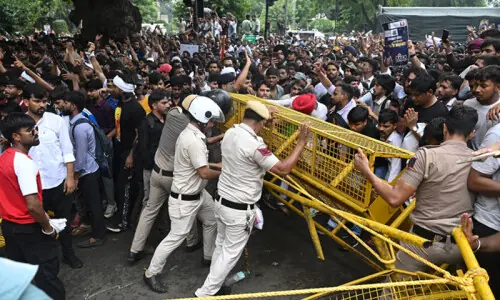
The May 9 riots by his followers pitched against his erstwhile sculptors, the ME, was his most damaging blunder. Before May 9, the emotive remnants of his charismatic authority that had also permeated within the military and the judiciary, was aiding him to avoid total disintegration. But after May 9, these too began to recede or were uprooted by a new ME and the government.
The party was finally over. He had danced his way up as a robust middle-aged man, but fell as a sad old man.
Published in Dawn, EOS, June 11th, 2023