Discos allowed to extract Rs16bn



ISLAMABAD: The National Electric Power Regulatory Authority (Nepra) on Wednesday concluded that ex-Wapda distribution companies (Discos) would charge an additional Rs1.61 per unit and K-Electric to refund Rs0.05 to their respective consumers for electricity consumed in April, under monthly fuel cost adjustment (FCA) mechanism.
The decisions were made upon completion of two separate public hearings. Discos would thus extract an additional amount of Rs15.63 billion and KE would refund about Rs72 million to their consumers in June’s bills.
The regulator also took up KE’s demand for a Rs5.2 per unit increase in tariff, involving a financial impact of Rs30bn, for the quarter ending March 31 under quarterly adjustment but reserved its judgement.
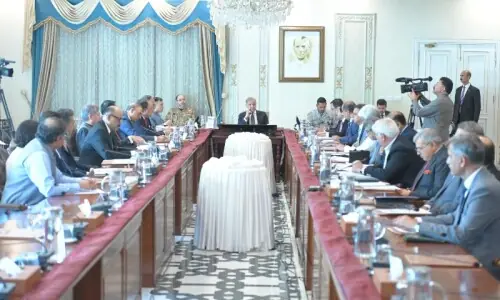
The public hearings were presided over by Nepra chairman Tauseef H. Farooqui and attended by three out of four provincial members — Maqsood Anwar, Muthar Rana and Amina Ahmed — from Khyber Pakhtunkhwa, Balochistan and Punjab.
The case officers of Nepra told the hearing that Discos had proposed an additional FCA of Rs2.01 per unit to generate about Rs19.5bn more. The regulator, however, calculated a positive FCA of Rs1.61 per unit with a revenue impact of about Rs15.63bn. The KE had sought 49 paise per unit increase in FCA to extract Rs740m from consumers but the regulator worked out a negative FCA of Rs0.048 per unit or Rs72m.
The adjustment on account of monthly FCA is also applicable to domestic consumers having Time of Use (ToU) meters irrespective of their consumption level.
One of the key reasons behind the FCA is a drop in hydropower generation and the resultant increase in the share of imported LNG-based generation in the overall power supply — making it the highest contributor at 24pc.
The second largest share came from nuclear generation at 19pc in April which was significantly down from 24.28pc in February. The contribution of hydropower generation in the overall national power grid in April dropped to 18.7pc against 26.46pc in February. Hydropower has no fuel cost. Power supply from coal-based plants stood at 18pc, up from 14.07pc in February followed by 12pc from domestic natural gas against 11pc in February.
Interestingly, the fuel cost of furnace oil-based power generation at Rs23.19 per unit was lower than the Rs23.86 per unit fuel cost of LNG-based power generation. However, the authorities produced just 2.2pc share from furnace oil-based generation compared to 24pc from LNG.
Published in Dawn, June 1st, 2023