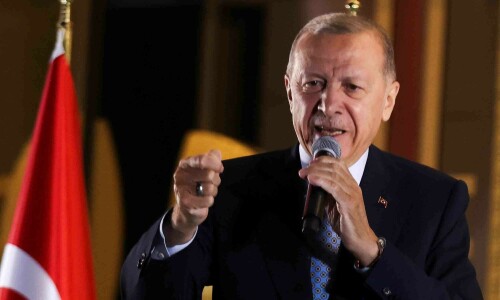
IN the end it was Recep Erdogan who won yet again. Over the weekend, the results of the run-off Turkish election revealed the former prime minister and current president to be the winner again.
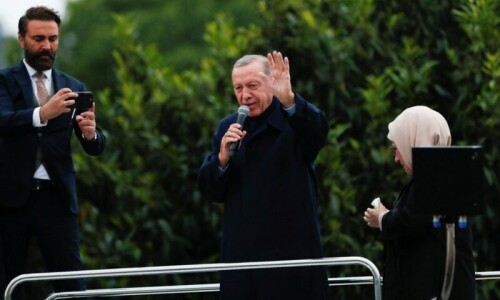
Erdogan declared victory in Üsküdar, a suburb of Istanbul that lies on the Asian side of the Bosphorus. Home to mainly middle-class Turks, where most women wear headscarves and the call to prayer can be heard clearly five times a day, the suburb is the type of place that is a stronghold of Erdogan’s party.
Atop a campaign bus, Erdogan congratulated his supporters and poked fun at his opponent whom he declared a Kemalist. It is worth remembering that the first major political office that Erdogan held was mayor of Istanbul and it was Erdogan who is credited with having improved the city as well as the services available to its residents.
Erdogan’s victory points to several emerging realities for Turkiye but also for the region at large. First, it is remarkable that Erdogan was able to eke out his 52 per cent victory despite the catastrophic earthquakes that hit the country just a few months ago, causing colossal damage besides killing thousands of people.
Critics blamed the government for not checking the violation of construction codes and for its inadequate response to the disaster; perhaps it was just that anger that kept Erdogan’s margin of victory to a couple of percentage points.
Even so, in the areas most affected by the earthquake, Erdogan still won most of the votes. Perhaps residents calculated that the stunning scale of the earthquakes would have crippled any government that tried to provide aid to those who were affected. What may have been enthusiastic votes for Erdogan were transformed, it appears, into reluctant votes for the long-standing leader; nevertheless, they were votes for him.
It is also true that while Western commentators put a lot of emphasis on how the Erdogan government had failed to coordinate with Western aid agencies, the Turkish people themselves may have put little stock in this, given the general mistrust with which Erdogan’s usual constituency views the international community. In the end, this election, like so many others in which Westerners get excited about an Erdogan ouster, he managed to keep his position as the leader of Turkiye.
While Erdogan may have won the Turkish election, the road ahead is paved with potholes and potential disasters.
In the months, even years, leading up to the election, much of the state machinery had been deployed to boost his chances. Among these was the state media; naturally, Erdogan had greater access to state-controlled media than was available to his opponents.
It is possible to argue that when Erdogan became mayor of Istanbul in the 1990s, he did so without having full access to state media. At the same time, it is important to remember that Turkish media has seen numerous purges over the last decade, a factor which pertains less to air time and more to the voices that are able to be heard on mainstream media. However, this may not have had an immediate effect on just this election; it seems that it has affected the general public discourse in the country, too.
At the same time, while Erdogan may have won, the road ahead is paved with potholes and potential disasters. One of the biggest issues is the economy. In order to keep the economy propped up prior to the election, the central bank that is controlled by Erdogan’s party kept handing out loans so that the economy would be flush with cash.
That may have been the case temporarily; now that those elections are over, and the results have been tabulated, the consequences are going to make themselves more visible. These consequences include an overvalued Turkish lira — a year or so before the election the lira lost a lot of its value against the dollar, then it stabilised some months ago. In any case, the lira has to be revalued and what remains could well drag the Turkish economy into a downturn spiral.
Meanwhile, a Turkiye still under Erdogan means more complications for Europe. Erdogan has never been as enthusiastic about the continuing war in Ukraine and has currently been opposing Sweden’s membership in Nato. This is of note not simply in the transactional sense of Turkiye using its position in Nato to bargain for other things, but also because it points to how ideologically empty the European Union has become as a bloc. It is no longer the liberal democratic powerhouse that once criticised Erdogan’s authoritarian tendencies.
The leftover EU that is still standing has its own democracies in decline, with some (like Hungary) making unabashed overtures at authoritarianism while others make more furtive advances in the same direction.
There is no doubt that the latest Erdogan term begins in a world even more complicated than usual. The two superpowers, the US and China, seemed poised to exchange barbs but have revealed little about the nature of a possible conflict between them. In the fragmented ‘rest of the world’, countries like Turkiye stand to wield much greater regional influence than was possible in the unipolar world of not long ago.
Whether or not the Turkish people had all this in mind when they set off to vote first in the initial election and then in the run-off is unknown. It is certain, however, that their not so new leader Recep Erdogan, having been on the world stage in some capacity or another for many decades, is uniquely qualified if not to be a world leader in his own right then at least a power broker that can transform the role that his country plays in the world to come.
The writer is an attorney teaching constitutional law and political philosophy.
Published in Dawn, May 31st, 2023