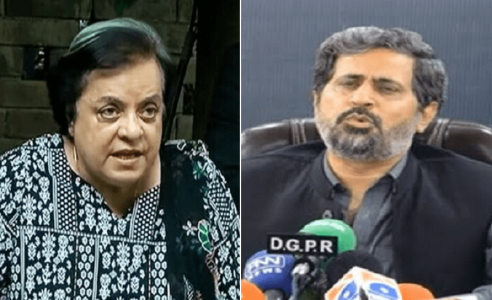
WHAT is happening now is not unfamiliar to Pakistan’s treacherous power politics. The signs of rupture are evident in its ranks as the PTI faces a massive crackdown.
Several prominent members — the latest among them Shireen Mazari and Fayyaz Chohan — have left the party and many others are lining up to exit. Former prime minister Imran Khan is paying the cost of taking on his powerful erstwhile patrons.
A protégé-turned-rebel has to be culled. The May 9 mayhem provided the establishment a justification to strike back with a severity not witnessed in recent times.
Several thousand PTI supporters have been detained in the clampdown. Almost the entire senior leadership has been incarcerated; some of them might be tried by military courts.
Imran Khan’s bail may have been extended again, thanks to the courts, but the noose is tightening around him. The maverick leader is facing the most serious test of his chequered political career.
Despite the defections, his popular base seems to have so far remained intact. But his political fortunes depend on how long — and if — the senior leadership can defy the establishment’s pressure and stand by him in his hour of reckoning.
The events of recent weeks have changed the country’s political landscape. It has brought the stand-off between the PTI and the security establishment to a head. It is an ironic reversal of the period when Khan was in power.
Some three years ago, speaking at a dinner for the then ruling coalition lawmakers, he had arrogantly boasted ‘we are the only choice’ for the establishment. But the game has changed as he finds himself pitted against the same institution. The May 9 incident seems to have closed all doors to reconciliation.
The maverick leader is facing the most serious test of his chequered political career.
Perhaps Khan believed that a show of street power could force the establishment to step back. He has singled out the army chief for his attack. In a recent interview to a foreign TV channel, he accused him of “attempting to impede his path to reclaiming power”. He seemed to have gotten carried away by the perception built by his supporters on social media of a division within the top brass.
But that brinkmanship has boomeranged. The widespread violence targeting army installations, particularly the vandalising of memorials to martyred soldiers, has provoked an intense reaction, especially in the battleground of Punjab.
Notwithstanding the heightened anti-establishment sentiments in the heartland whipped up by Khan’s narrative, the May 9 violence has changed the situation. A massive media campaign launched by the PDM government highlighting the destruction perpetrated by its supporters has also put the PTI on the back foot.
It has allowed the security agencies to launch a vicious clampdown on PTI supporters not witnessed in recent times. There have also been reports of brutal violations of human rights. Even those senior members who haven’t left the party are being compelled to denounce the violence.
Imran Khan, too, after resisting for days, finally decried the attacks on the military installations. But it has not helped ease the stand-off. The establishment is not willing to forget what has happened and the army has termed the events of May 9 a “dark chapter” in the country’s history.
The intensified confrontation between Khan and the military establishment has given the shaky ruling coalition some space. Its entire effort seems to be to get the PTI declared a terrorist group or at least get Imran Khan out of the electoral field. This so-called minus-one formula to keep political leaders out of the arena has never worked in the past and will not work now.
Indeed, Imran Khan too has hit a dead end with his confrontational politics. His shifting narrative has raised questions about his credibility. He is now contradicting his initial claims of an American conspiracy for regime change. After bashing America for months, he is now seeking the help of American lawmakers to put pressure on the Pakistani establishment to stop the crackdown on his party.
There is no mention of an American conspiracy in engineering his ouster anymore. Khan is doing exactly what he has been accusing his rival parties of doing: seeking foreign intervention. His turnaround may not change his hard-core support base but his false narrative of regime change conspiracy has hugely damaged the democratic process in the country.
The latest crackdown on his party has narrowed Khan’s options. The exodus, first of the second- and third-tier, and with Dr Mazari’s departure the top level, has had a demoralising effect on party ranks.
The party may not disintegrate but the cracks can widen further as the stand-off with the establishment continues. With its main support base among the middle classes, the party cannot withstand this kind of repression.
What has worsened its plight is that the party has isolated itself from other political forces, refusing to talk to them. Perhaps most damaging for the party has been Khan’s decision to pull out of the National Assembly and prematurely dissolve the Punjab and KP assemblies.
Earlier, Imran Khan had unsuccessfully tried to bring down the PDM government through street power. Instead of fighting his battle in parliament, he chose to take to the streets.
Khan tried to demolish the entire edifice thus weakening the democratic process and consequently strengthening the establishment. In his arrogance, he failed to understand that he could only return to power through a democratic process.
He may have succeeded in mobilising mass support largely because of his false narrative of regime change and the disenchantment of the public with the PDM government’s flawed policies. But he failed to build a strong political structure on a solid programme.
He took on, simultaneously, rival political forces and the establishment, which has cost him dearly. And as he took on the establishment he also looked to it for support. Populism has its limitations, which Khan has never understood.
The way the party has crumbled in the face of state repression is unprecedented. It is the former prime minister’s moment of truth. It remains to be seen if he can learn from his mistakes.
The writer is an author and journalist.
Twitter: @hidhussain
Published in Dawn, May 24th, 2023