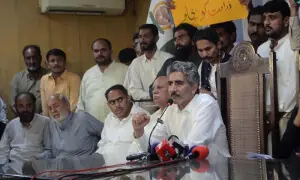
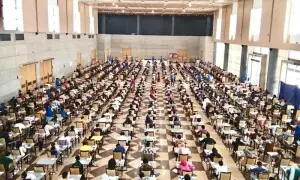
A FEW months ago, I attended a seminar on education where the Sindh education minister was the chief guest. When he rose to speak, a mob of demonstrators gatecrashed the premises to register their protest. The government had conducted a test to fill teacher vacancies in schools. Very few had passed the test and been recruited. Those who failed to qualify were demanding a job as their entitlement. In the melee, the right of the child did not figure even once.
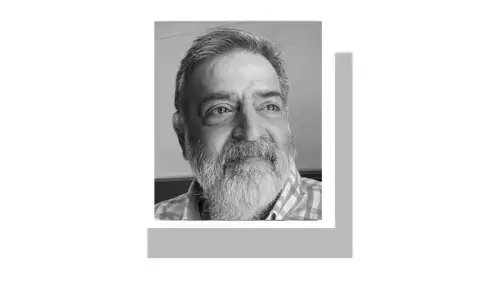
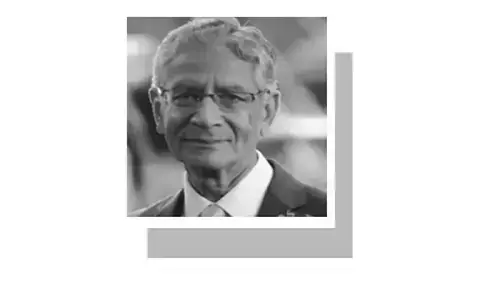
More recently, the role of a teacher again found mention in my discourse. I had the good fortune to talk to Vali Ram Vallabh, Sindh’s eminent litterateur. His mild manners and scholarship impressed me immediately, and spontaneously, I asked him to describe his teachers who had launched him on his long journey of learning and enlightenment.
He began his education at the village school in Chelhar (Tharparkar) where his father was posted. The young Vali Ram’s first encounter with a teacher was an inspiring one. He met Rai Chand Hari Chand, a gentle, soft-spoken man who was the school headmaster. He was an author and a book lover too who had made it a point to set up a library in the school. He introduced Vali Ram to books that became his passion for life.
Another teacher, who taught him in Mithi, was so free of prejudices that he introduced himself in class with these words, “My name is Ziaul Haq but you may call me Om Prakash [the light of truth] as the two mean the same.” It was nigh impossible for any student of such fine teachers to grow up to be a bigoted book-hater. So deep was the imprint they left on Vali Ram’s personality that he went on to earn three MA degrees and also a degree in law. Irrespective of his job — in the Forest Department and later at the Institute of Sindhology in Jamshoro — he continued to read books and write/translate them while leading a simple life. He adopted Vallabh (love) as his pen name that reflects the positive impact that his teachers had on him.
Language has connected Vali Ram with his readers abroad — the Sindhi-speaking diaspora.
At the root of his professional achievements and personal relationship with his readers is his mother tongue — Sindhi. He considers language to be an important element that binds people to their culture and society, while facilitating communication. He learnt many languages in school, starting with his mother tongue Sindhi, followed by Urdu. Those were the days when it was generally believed that language made a man cultured. Vali Ram learnt Sanskrit, Persian and finally English as well. “I would read Sindhi books to my father and he would listen carefully. Thus I learnt about the bonding power of a language that can bring two generations together,” he said.
Language has connected him with his readers abroad, the Sindhi-speaking diaspora who yearn for their past life. The writers among them have written about their lost motherland in Sindhi and sent him their books as they are aware that Vali Ram is an avid reader. He believes that language, especially the mother tongue of a community, connects people with one another and consolidates societies and cultures.
Though Vali Ram earned his bread and butter through government service, his interest and competency in languages became food for the soul. He wrote fiction, non-fiction and poetry in Sindhi. But his forte was his exquisite translation into Sindhi of works of authors as diverse as Qurratulain Hyder (Aakhir-i-Shab Kay Humsafar), Krishen Chandar (Ghaddar), Amrita Pritam (Band Darwaza) and Albert Camus (The Outsider). He has translated nearly 40 books — two of then anthologies of poems —
and nearly 100 short stories. The common thread running through the works he translated is that they inspired him and have a progressive theme. He takes pride in his choice of books to translate — never agreeing to translate a book as an assignment.
For Vali Ram, translation is creative writing that makes the translator a cultural activist who widens his readers’ literary horizons. Hence it is for him to decide what he wants to translate. Although the author claims ownership of his book, it is the translator who enhances its value by increasing its readership. Vali Ram believes that a book that is not translated remains confined to one language only. But once a translator picks it up, its worth goes up as it enriches world literature.
Books mean a lot to Vali Ram who observes that the higher the moral and spiritual values of a society, the more it cherishes books. When creative literature is at its peak, translation also flourishes. This holds true for Sindhi as well.
Contributing to this process is the translator Vali Ram who, as Goethe would say, is a part of the process of bringing the universe together.
Published in Dawn, May 5th, 2023