Indian Air Force dismisses group captain for downing own chopper in Feb 2019


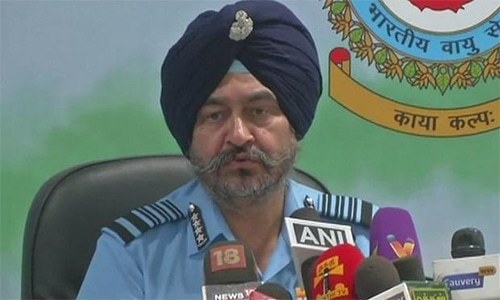
A General Court Martial (GCM) in India has ordered the dismissal of an Indian Air Force (IAF) group captain for a friendly missile attack on an Mi-17 helicopter in February 2019, according to a report published in Tribune India.
On February 27, 2019, an Indian Mi-17 helicopter crashed, killing seven people, including IAF personnel, during a “routine mission”.
The incident took place around the same time and on the same day when Pakistan Air Force (PAF) undertook strikes across the Line of Control (LoC) from Pakistani airspace as part of Operation Swift Retort after India violated the boundary and struck Balakot.
According to a report by Tribune India published on Monday, the GCM ordered the dismissal of group captain Suman Roy Chowdhury, who was the chief operations officer of the IAF at the Srinagar Air Force station at the time of the friendly missile attack.
The report said that Chowdhury was held guilty on five of the nine charges. It added that he was held guilty of not obeying the general order issued by the air headquarters as he had permitted the Mi-17 to get airborne from Srinagar without the “Identification Friend or Foe” on.
He was also held guilty of assigning an inbound flying object to the missile unit on Feb 27, 2019. “As a consequence, the assigned flying target, which actually was friendly copter Mi-17, was shot down by a Spyder missile at 10:14am. The mishap caused a loss of Rs133.31 crore to the state,” the report said.
Meanwhile, the report added that Wing Commander Shyam Naithani, who was the senior air traffic control officer at the time of the incident, had been acquitted of four charges and had gotten “a severe reprimand for one charge”.
How Operation Swift Retort unfolded
The epicentre of the Pakistan-India escalation was an attack in occupied Kashmir’s Pulwama on Feb 14, 2019, in which more than 40 Indian paramilitary soldiers were killed.
The attack, surpassing one in 2016 when 19 soldiers died, saw explosives packed inside a van rip through buses in a convoy of 78 vehicles carrying some 2,500 members of the paramilitary Central Reserve Police Force.
Two blue buses carrying around 35 people each bore the brunt of the explosion around 20 kilometres from the main city of Srinagar on the main highway towards Jammu.
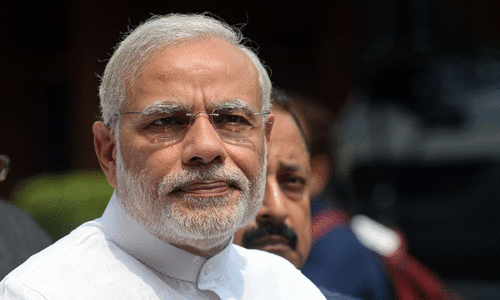
The next day, Indian Prime Minister Narendra Modi said his country would give a “strong response” to the Pulwama attack.
The “blood of the people is boiling” and forces behind the act of terrorism will be definitely be punished, he was quoted as saying by Hindustan Times.
Modi didn’t name Pakistan but went on to say: “If our neighbour, which is totally isolated in the world and thinks it can destabilise India through its tactics and conspiracies, then it is making a huge mistake”.
The situation heated up when Indian military planes violated the Line of Control, intruding from the Muzaffarabad sector. “Pakistan Air Force immediately scrambled” and Indian aircraft went back, the ISPR had said in a statement.
The intrusion in Pakistani airspace by Indian Air Force (IAF) aircraft had happened for a second consecutive day, as one of its planes had to release payloads in the Balakot area while being chased away in the early hours of the day. The Pakistan military spokesman had then promised “surprise” for India in response to the IAF aggression.
A day later, the IAF jets entered Pakistani airspace after the PAF strikes on the other side of the LoC from Pakistani airspace for, what the Foreign Office and Army had described as, a demonstration of Pakistan’s “right, will and capability for self-defence”.
The PAF strikes across the LoC were first announced by then FO spokesman Dr Mohammad Faisal via a tweet. “PAF undertook strikes across LoC from Pakistani airspace. The sole purpose of this action was to demonstrate our right, will and capability for self-defence. We do not wish to escalate but are fully prepared if forced into that paradigm,” he had tweeted.
Shortly afterwards, the then Pakistan military spokesman Maj Gen Asif Ghafoor announced the shooting down of IAF aircraft. He had tweeted, “IAF crossed LoC” after the PAF strikes in occupied Kashmir.
“PAF shot down two Indian aircraft inside Pakistani airspace. One of the aircraft fell inside AJK while the other fell inside IOK. One Indian pilot arrested by troops on the ground while two in the area,” he had stated.
Abhinandan Varthaman was the Indian pilot captured. He was handed back to India in a goodwill gesture shortly after.