Weekly inflation spikes to 42.27pc



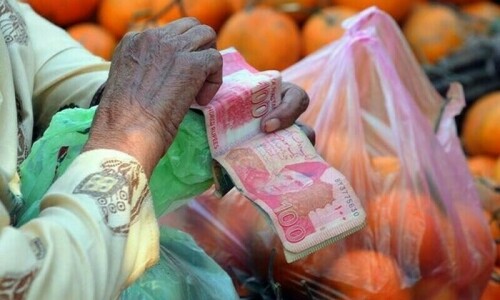
ISLAMABAD: Weekly inflation clocked in at 42.27 per cent year-on-year owing to the rising prices of edible oil, pulses and vegetables, according to data released by the Pakistan Bureau of Statistics (PBS) on Friday.
Short-term inflation, measured by the Sensitive Price Index (SPI), is expected to intensify further as the full impact of depreciation, hike in general sales tax rate and higher energy prices has yet to reflect in official data.
Week-on-week inflation remained 1.37pc for the seven-day period ending on March 9, with bananas, chicken, sugar, cooking oil, gas and cigarettes becoming costlier.
The weekly inflation number is the highest since the week ending on Sept 8, 2022, when SPI was 42.7pc. It stayed above 40pc for the first time since Sept 15 last year when the reading was 40.58pc.
Of the 51 items in the SPI basket, prices of 29 items increased while those of eight items decreased. Rates of 14 items remained stable.
During the week under review, the items whose prices increased the most over the same week a year ago were onions (305.23pc), cigarettes (165.66pc), gas charges for the first quintile (108.38pc), diesel (93.82pc), eggs (78.63pc), rice Irri 6/9 (78.14pc), petrol (77.89pc), rice basmati broken (77.27pc), bananas (74.01pc), pulse moong (72.54pc), tea Lipton (66.31pc), pulse mash (56.02pc), pulse gram (55.97pc) and bread (55.36pc).
In contrast, the highest year-on-year fall was recorded in the prices of tomatoes (41.79pc) and chilli powdered (7.42pc).
On a week-on-week basis, the biggest change was noted in the prices of tomatoes (12.43pc), potatoes (11.37pc), onions (9.26pc), sugar (5.48pc), bananas (5.31pc), cooking oil-five litres (4.27pc), wheat flour (4.06pc), vegetable ghee-2.5kg (4.01pc), curd (1.89pc), milk fresh (1.82pc), tea Lipton (1.79pc), rice basmati broken (1.24pc), salt powdered (1.21pc), lawn printed (2pc) and shirting (1.45pc).
Products whose prices saw the highest decline over the previous week were chicken (6.73pc), garlic (2.07pc), pulse moong (0.83pc), eggs (0.77pc), pulse masoor (0.50pc), LPG (0.26pc), firewood (0.12pc) and pulse gram (0.05pc).
The government has been taking strict measures under the International Monetary Fund (IMF) programme, which is likely to slow down economic growth and stoke inflation.
The increase in the policy rate to 20pc, general sales tax rate from 17pc to 18pc on most items and to 25pc on more than 800 imported food and non-food items will further increase retail prices of consumer goods.
The government has already taken a string of measures, including adopting a market-based exchange rate, hikes in fuel and power tariffs, withdrawal of subsidies and higher taxation, to generate revenue for bridging the fiscal deficit.
Published in Dawn, March 11th, 2023