Tens of thousands protest in Greece over deadly train crash


 0
0



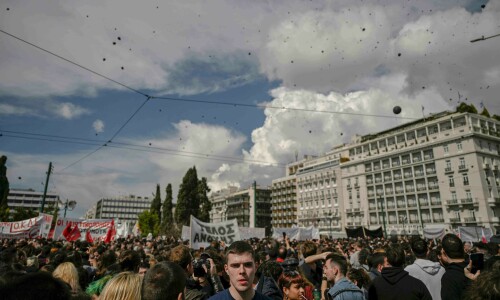
Tens of thousands of people marched in Greece on Wednesday to protest over the country’s deadliest train disaster on record, as workers staged a nationwide, day-long walkout.
The crash on Feb 28 killed 57 people and has stirred public outrage over the crumbling state of the rail network. Striking workers say years of neglect, underinvestment and understaffing — a legacy of Greece’s decade-long debt crisis — are to blame.
More than 40,000 people, among them transport workers, students and teachers, marched in central Athens chanting “Murderers!” and “We are all in the same carriage”.
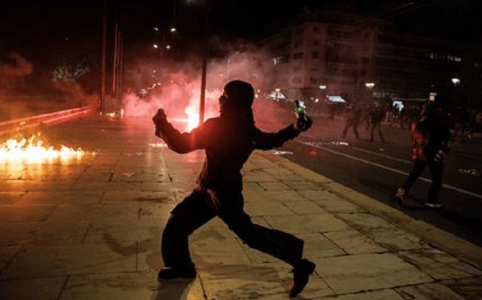
A group of protesters clashed with police, who fired tear gas at the crowd.
Thousands also took to the streets in Greece’s second-biggest city of Thessaloniki, where a group of protesters hurled stones at a government building.
The protests coincided with a 24-hour strike called by workers of different sectors, which disrupted travel across the country.
Many of the around 350 people aboard an intercity passenger train that collided head-on with a freight train while travelling on the same track were university students heading north to Thessaloniki from Athens.
The disaster has sparked protests across Greece over the past week.
“Message me when you get there,” a placard in Athens read, echoing what has become one of the protest slogans.
“You feel angry because the government did nothing for all of those kids. The public transport is a mess,” said 19-year-old Nikomathi Vathi.
“We’re going to be here until things change,” said another student, Vaggelis Somarakis. “We are the youth of this country and we’re not going to stop.”
The conservative government, was initially planning to call elections in the coming weeks, promised on Wednesday to fix the ailing railway system.
Transport Minister George Gerapetritis told a news conference he understood the anger the accident had caused.
“No train will set off again, if we have not secured safety at the maximum possible level,” he said, apologising for Greece’s deadliest rail crash on record.
‘No time for silence’
Rail workers have staged rolling, 24-hour strikes since Thursday, bringing the network to a halt. On Wednesday, the government also suspended the service while it reviews safety.
The workers say their demands for improvement in safety protocols have gone unheard for years and have promised to “impose safety” to ensure that a crash will not be repeated.
“We have an obligation towards our fellow humans and our colleagues who were lost in the tragic accident,” the main railway workers’ union said.
Greece’s largest public sector union ADEDY participated in the 24-hour strike.
City transport workers walked off the job in solidarity, disrupting metro, tram and bus services in the capital. Ships also remained docked at ports as seamen participated in the labour action.
“It’s not the time to fall silent,” a teachers’ union said in a statement.
The government, whose term expires in July, has blamed the crash mainly on human error and deficiencies it says have not been fixed over the past decades.
Prime Minister Kyriakos Mitsotakis has handed the portfolio to Gerapetritis, one of his closest allies. Gerapetritis said rail passenger services may resume by the end of March if safety is secured.
He said funds would be invested in upgrading infrastructure and hiring staff, and also promised to shed light to the causes of the crash.
Gerapetritis was due to meet transport experts from the European Commission, which has said it will offer technical support, later on Wednesday.
Greece sold its state-owned railway operator, now called Hellenic Train, to Italy’s state-owned Ferrovie dello Stato Italiane in 2017 during its debt crisis.
The sale was a term in the country’s bailout agreements with the European Union and the Washington-based International Monetary Fund.