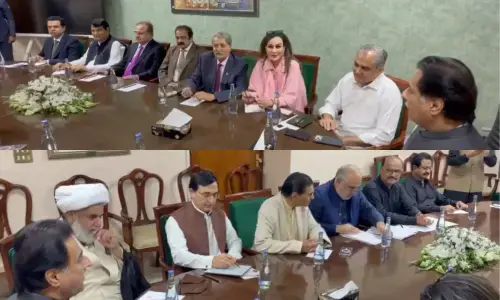
LARKANA: Speakers at the “Sindhi Boli Conference” reiterated the demand on Tuesday that the government should accord Sindhi the status of a national language besides preparing plans for the progress and development of other languages as well.
The conference was held at the Arts Council of Larkana in memory of noted writer, researcher and former chairman of the Sindhi department and adviser to Bhittai Chair in Karachi University, Ayaz Qadri.
Mukhtiar Malik, writer and former broadcaster who presided over the moot, said the origin of Sindhi language had been very crucial and it was a topic having wider scope which had been discussed and deliberated upon since the British era in Sindh.
He said many linguists and writers had termed it an offshoot of ancient Sanskrit language, but Dr Nabi Bakhsh Baloch had contradicted that idea and claimed that Sindhi had nothing to do with Sanskrit.
He for first time informed that Sindhi belonged to the Semitic family of languages and had taken birth from an ancient language of Indus civilisation, Mr Malik said.
He said Larkana was a historical and literary place where many seasoned researchers and historians were born; therefore, they should work to decipher Indus script. Being the sons of soil, it was obligatory upon them to contribute intellectually for its betterment, he said.
Dr Altaf Jokhio, prominent linguist, said conspiracies were being hatched to eliminate Sindhi from the annals of history immediately after the establishment to Pakistan, but “thanks to those of our literati who raised voice for it and kept it alive”.
That language had seen much ups and downs of time and faced many hardships, but being rich in its literature, it kept thriving, he said.
Prof Azhar Ali Shah, pro vice chancellor of Larkana campus of the University of Sindh, said that traces of Indus Valley Civilisation had been found in 1922, but despite the passage of long time, “we have failed in decoding Indus script, which is a matter of great concern”.
Dr Sikandar Mughal, who had six books to his credit on science, evolution etc., said: “This is an era of globalisation in which the boundaries between nations, and their languages and literatures have vanished.”
He said the nations had been sharing their languages and literatures with each other; hence, the languages of smaller nations were feeling inferiority. Sindhi language was also feeling so, which was matter of bewilderment. Private schools were also ignoring Sindhi language, which was also matter of concern for people, he added.
Published in Dawn, February 22th, 2023