Short-term inflation measured by the Sensitive Price Index (SPI) jumped to 38.42 per cent year-on-year (YoY) for the week ending on February 16 driven by high food and fuel prices, data shared by the Pakistan Bureau of Statistics (PBS) showed on Friday.
Last week, short-term inflation was recorded at 34.83pc year-on-year.
On a week-on-week basis, SPI increased 2.89pc compared to a rise of 0.17pc in the preceding week. This is the highest weekly rise since October 27, according to Arif Habib Limited.
The SPI monitors the prices of 51 essential items based on a survey of 50 markets in 17 cities across the country. During the week under review, the prices of 34 items increased and five decreased while 12 remained unchanged.
Highest YoY rise
- Onions: 433.44pc
- Chicken: 101.86pc
- Diesel: 81.36pc
- Eggs: 81.22pc
- Rice (Irri-6/9): 74.12pc
Highest YoY fall
- Tomatoes: 65.3pc
- Chili powder: 7.42pc
- Electricity for group earning up to Rs17,732 per month: 7.5pc
Highest WoW rise
- Petrol: 8.82pc
- Cooking oil 5 litres: 8.65pc
- Ghee 1 kg: 8.02pc
- Chicken: 7.49pc
- Diesel: 6.49pc
Highest WoW fall
- Tomatoes: 14.27pc
- Onions: 13.48pc
- Eggs: 4.24pc
- Garlic: 2.1pc
- Flour: 0.1pc
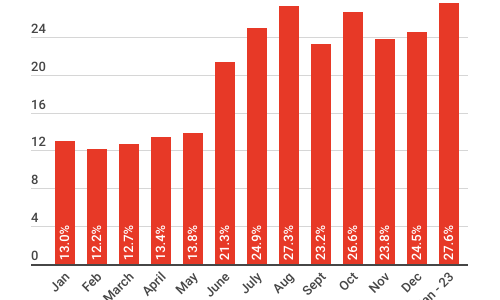
Pakistan has been in the grips of decades-high inflation in the past few months. In January, annual inflation measured by the Consumer Price Index (CPI) spiked 27.55pc — the highest increase since May 1975.
Inflation has been driven in part due to the devastating floods last year that destroyed swathes of agricultural land, leading to a shortage of some food items. Separately, importers have had trouble getting banks to open letters of credit (LCs) as the country’s foreign exchange reserves depleted to a critically low level. This also drove up the prices of essential items, including flour and pulses, in recent weeks.
Inflation is expected to increase further in the coming months as the government implements conditions agreed upon with the International Monetary Fund (IMF) for an economic bailout, including a hike in electricity and gas prices.
A senior economist with Moody’s Analytics said recently that headline inflation could average 33pc in the first half of the current fiscal year before trending lower.
Low-income households could remain under extreme pressure as a result of high inflation on account of being disproportionately exposed to non-discretionary items.
“Food prices are high and they can’t avoid paying for that, so we’re going to see higher poverty rates as well feed through,” the economist said.