DNIPRO: Russia and Belarus began joint military exercises on Monday, triggering fears in Kyiv and the West that Moscow could use its ally to launch a new ground offensive in Ukraine.
The two allies will conduct air force drills from Jan 16 to Feb 1 using all Belarus military airfields and began joint army exercises involving a “mechanised brigade subdivision” on Monday, the Belarusian defence ministry said. Minsk says the air drills are defensive and it will not enter the war.
Russia had used its neighbour Belarus as a springboard for its invasion of Ukraine last February.
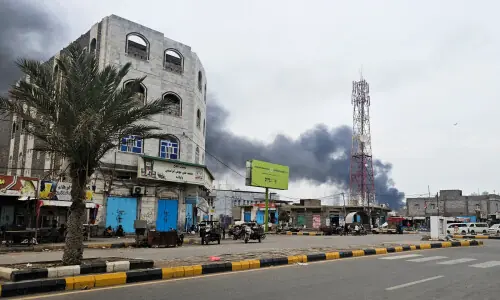
In his address after the Dnipro strike, Ukraine President Volodymyr Zelensky called on Western allies to supply more weapons to end “Russian terror” and attacks on civilian targets. Britain followed France and Poland with promises of further weapons, saying it would send 14 of its Challenger 2 main battle tanks as well as other advanced artillery support in coming weeks.
The first despatch of Western-made tanks to Ukraine is being viewed by Moscow as escalation of the conflict.
The Russian Embassy in London said the tanks would drag out the confrontation.
On the other hand, Poland’s Prime Minister Mateusz Morawiecki on Monday urged Germany to send Ukraine the weaponry it needed to take the fight to invading Russian soldiers, lacing a speech in Berlin with implicit criticisms of Chancellor Olaf Scholz’s government.
Speaking at a gala marking conservative former German Finance Minister Wolfgang Schaueble’s half-century in parliament, Morawiecki said Europe’s collective conscience would be burdened if it did not help Ukraine more. “I call for decisive actions by the German government,” he said.
“The battle for freedom and our future is raging as we speak... Tanks must not be left in storehouses, but placed in their hands.”
Germany has come under pressure from allies to allow the use of German-built Leopards in Ukraine. Eastern and central European Nato allies mainly rely on German-built Leopards, seen as the Western tanks most suited to forming the core of a new Ukrainian armoured force.
German minister resigns
As Berlin was under intense pressure to provide battle tanks to Kyiv, German Defence Minister Christine Lambrecht resigned. Her decision came just days ahead of a crucial meeting of defence ministers from Ukraine’s allies.
A spokeswoman for Chancellor Olaf Scholz said he would announce a replacement for Lambrecht “in the near future”.
Lambrecht, 57, said she had asked Scholz to relieve her of her duties. “The months-long media focus on my person hardly allows for objective reporting and discussion about servicemen and women... and security policy decisions in the interest of the citizens of Germany,” she said.
The politician from Scholz’s Social Democrats (SPD) had faced criticism for months over what some see as Germany’s wavering response to the conflict in Ukraine.
Berlin is under pressure to quickly nominate a new defence minister ahead of US defence secretary Lloyd Austin’s visit to the US military base in Ramstein, Germany this week.
Finland’s response
Finland President Sauli Niinisto said the country could donate a small number of Leopard 2 tanks to Ukraine if a wider group of European nations also decided to do so. He said the topic would be discussed later this week, possibly first at a meeting in Tallinn in which Estonia has invited “like-minded countries”, and at the US military base in Germany.
Finland’s stance on giving Leopard tanks to Ukraine depends on Germany’s lead, Finnish defence minister Mikko Savola said, adding that exporting the German-made equipment would require a permit from Germany.
Tanks ‘will burn’ in Ukraine: Russia
On Monday, the Kremlin said tanks Britain plans to send to Ukraine “will burn”, warning the West that supplying a new round of more advanced weapons to Ukraine would not change the outcome of the war.
Britain earlier said it would send 14 of its Challenger 2 main battle tanks as well as other advanced artillery support in the coming weeks.
“They are using this country as a tool to achieve their anti-Russian goals,” Kremlin spokesman Dmitry Peskov said when asked about the British tanks.
“These tanks are burning and will burn just like the rest,” Peskov said.
Peskov said the new supplies from countries like Britain and Poland would not change the situation on the ground, but were an attempt to draw out the conflict which he said would ultimately bring “more troubles” on Ukraine.
Published in Dawn, January 17th, 2023