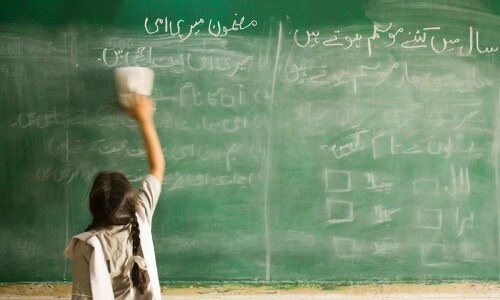
PRIMARY grade students at public schools come mostly from the poor and lower middle classes and speak a range of languages as their mother tongue. Unfortunately, when the latter is supplanted by Urdu, English or Arabic, the students find it difficult to communicate, let alone grasp knowledge.
Students from elite classes are privileged; they use advanced technology, watch TV at home and speak English with their parents and friends. What do their disadvantaged peers have to go through? Their schools lack sanitation facilities and potable water; they are malnourished, which has a negative impact on their academic growth. Even at that age, many of them have to supplement the family income. Before any comparisons are made, the public sector should receive more support as an ‘equity measure’.
Improving public education is the only answer, rather than worsening it in the name of privatisation — or selecting the naturally gifted to study at elite institutions, as some have proposed. How can those institutes maintain their credibility if only natural talent is chosen? Instead, they must admit average and below-average students and make them outstanding. It may put their systems to the ultimate test but it must also be realised that it is not that our youngsters themselves are below par; rather, it is the badly managed educational system, which limits their abilities.
Picking up natural talent and turning it into a brand will only intensify social stratification. Our English monarchs used the same strategy — constructing certain elite institutes to train students who would carry on their legacy. “I know my children are not brilliant and may not count in higher positions, but they will have powerful acquaintances, since this college has produced all the prominent people,” a father once observed.
What do disadvantaged students have to go through?
Since independence, those in power have represented the same elite-grown entities. What revolutionary services are available for the common man, especially in terms of education? We continue to think and act in the same way, polarising society and using education as a means to do so. Fee tokens for students in private schools, for example, ‘legalises’ education as a commodity, which further strengthens power centres, all the time focusing more on ‘power as knowledge’ rather than ‘knowledge as power’. Education — quality education — is a fundamental human right that cannot be denied. More significantly, it is the obligation of the state’s public schools, and not the private institutions, to educate our children.
What should change is the key question. A systemic overhaul from the top to the bottom tier is required. Shouldn’t it begin with an educationist as the education minister? On a lighter note, if there is not one in the political lot, then we’d better import one….
Let us consider the asymmetries in competence at the highest level, when an officer has sole control of everything — from transfer/posting to policy formation. The officer may not be incompetent, but poor systemic arrangements will cut his talent down to size.
Is it logical to push a person to serve in completely different disciplines for varying lengths of times — from Customs and narcotics, to education, followed by agriculture? How can we make sustainable plans and policies if an officer cannot be retained in a single sector for a longer term? Can’t we have specialised authorities in charge of education for the duration of their service?
Similarly, there is a need to revisit teachers’ appointments, promotions, and age of retirement. For example, ‘age-based’ promotion does not make sense. One study found that students learn more from younger teachers than from older teachers, while we pay older teachers more and promote them to higher grades.
Another debate is whether every person requires formal education and whether we can assure this, given the high rate of population expansion. A proportion of the people may benefit from vocational education to become entrepreneurs and contribute to the economy. China’s success, among other factors, rests on expanding vocational opportunities for its common citizens, using schools as the primary mechanism for offering open and flexible vocational education based on a government-market link. Their houses are small industrial enterprises that contribute significantly to the local economy.
Opening a number of private schools would suit the philanthropist, not the state. States establish systems, develop and implement accountability measures, and ensure strict compliance. Our most common dilemma is viewing education in isolation from the socioeconomic, sociopolitical, and sociocultural landscape in terms of learning design and supportive mechanisms. We hear all the time that political stability is positively correlated with economic stability, and that is indeed the case. The same can be said for education, which has sadly fallen out of sight.
The writer is an educationist.
Published in Dawn, January 2nd, 2023