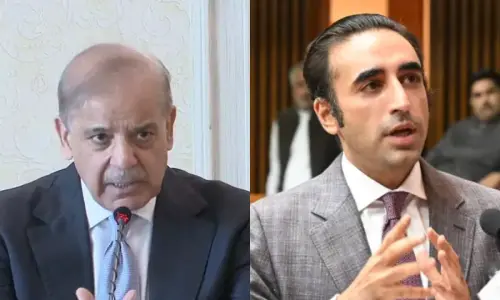
ADDRESSING the Institute of Strategic Studies Islamabad in June, Foreign Minister Bilawal Bhutto-Zardari called for a “deep rethink” of our foreign policy. This was a clarion call, indeed, that was endorsed by most thought leaders, given the changing geopolitics of our region. Six months down the line, as 2022 comes to a close, it is worth introspecting over whether our foreign policy has been revisited in any respect.
Let us start with our eastern neighbour, which remains contemptuous of Pakistan. For over six years, dialogue between the two countries has been at a standstill. The recent verbal spat in New York between the foreign minister and his Indian counterpart has revealed the depth of the mutual acrimony. The larger question that both countries must ponder is that if they remain at daggers drawn, can the region ever prosper?
Having squandered peace opportunities in the 1999 Lahore process, the 2007 four-point formula, and the 2015 resumption of dialogue, the two countries appear stuck in a long spell of estrangement. The unwavering hostility demonstrated by the BJP-led government since the start of its second term and the illegal annexation of Kashmir in 2019 indicates that India was not interested in normalising ties with Pakistan. Meanwhile, our region remains the least integrated and its prosperity is handicapped. Perhaps some out-of-the-box thinking is required for both to break the logjam.
On the west, the Taliban government in Kabul continues to spring surprises on Pakistan. They have fallen short of meeting any of the expectations of the international community: forming an inclusive government, respecting women rights and ensuring counterterrorism measures. Most disconcerting for Pakistan is the space they have given to anti-Pakistan elements, particularly the TTP. The hypothesis that we nurtured for 40 years; that a Pakistan-friendly government in Afghanistan would bring lasting peace on our western frontier has not worked. The Taliban takeover of Afghanistan seems to have encouraged their Pakistani counterparts, the TTP, to attempt to take over as much of Pakistani territory as possible to establish their own emirate.
Our region remains the least integrated.
Unfortunately, a hot war is now unfolding on our western frontier, which warrants a firm diplomatic and military response. We must not pretend that we can influence the Taliban’s behaviour by supporting their economy and trade and pleading their case with the Western world. Afghanistan is an independent country, and must be engaged with on the basis of mutual respect and benefit.
Iran, once a close friend, remains bogged down in its own problems, internal and external. The US sanctions have not allowed Pakistan to benefit much from its economic interactions with Iran. Fortunately, there is no entrenched bilateral conflict with Iran. We could have, and should have, better utilised the border crossings for expanded barter trade rather than leaving the space wide open for smugglers.
That leaves China, our northern neighbour, as the only country that continues to profess an unambiguous friendship with Pakistan. However, with our political instability and shaky economy, Chinese investors are wondering if they should put their stakes in Pakistan, unless they receive assured returns and the safety of their nationals is ensured. While CPEC investments were pouring into energy and infrastructure, we should have simultaneously worked on creating special economic zones to attract Chinese industry. Improving the ease of doing business is also a strategic imperative. Gwadar, the gateway to CPEC, remains grossly underutilised, despite its truly high potential.
Our major foreign policy preoccupation at this point seems to be on how to have the loans provided to us by lenders rolled over so that we can live another day. We speak of economic diplomacy, but our trade and economic interactions within our region remain abysmally low. We should also have found ways to avail the economic reorientation currently underway in the GCC.
Among major powers, our relations with the US have only marginally improved, and are still laced with tentativeness. We earn our foreign exchange through exports to the US and Europe, but then quickly consume it to pay for much larger imports that we cannot afford. Russia has done precious little for Pakistan, even though we abstained on the UN resolution condemning its aggression against its smaller neighbour Ukraine.
With all of the above in mind, one wonders if we are even ready for the deep rethink that we all desire. For this to happen in earnest, we must introspect over whether rhetoric has overtaken a rational pursuit of national interest. What our country needs most is introspection and a relentless pursuit of national economic interests in all our foreign relations. It is perhaps our mindset that needs a deeper rethink before policy reforms can truly be achieved.
The writer is a former foreign secretary and author of Diplomatic Footprints.
Published in Dawn, December 25th, 2022