Not ‘pursuing or receiving’ discounted energy from Russia, FM Bilawal tells PBS NewsHour


 19
19

Foreign Minister Bilawal Bhutto Zardari — who is in the US for a seven-day visit — has said that Pakistan “is not pursuing or receiving” any discounted energy from Russia.
Last week, State Minister for Petroleum Musadik Malik had announced that Russia had decided to provide crude oil, petrol, and diesel to Pakistan at discounted rates.
He had said that detailed terms and conditions of the discounted oil commodities would be settled during the upcoming visit of the Russian energy minister to Islamabad by mid-January, but rates would be similar to the discount being given to other countries or even cheaper.
Before that visit, the two sides would crystallise proposals to a stage where an executive summary or an agreement could be signed and supplies start flowing, Malik had added.
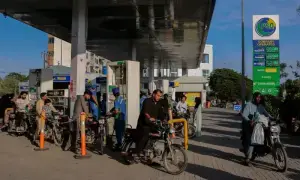
Pakistan struggles to meet domestic gas supply needs as winter approaches while battling to contain a current account deficit swelled by energy payments, mostly for oil.
The country has been unable to procure Liquified Natural Gas from the international market because spot prices remain out of its range and shipments under long-term deals remain insufficient to match rising demand.
In an interview with journalists Amna Nawaz and Judy Woodruff on ‘PBS Newshour’ on December 14, the PPP chairman said: “As far as Russia is concerned, we aren’t pursuing or receiving any discounted energy, but we are facing an extremely difficult economic situation, inflation, pump prices.”
He, however, admitted that Pakistan was facing energy insecurity.
“We are exploring various avenues to expand our areas where we can get our energy from,” FM Bilawal said, adding that “any energy from Russia will take a long time for us to develop.”
‘Pakistan to engage with both China and US’
In response to a question on whether Pakistan would ally with the US and still do business with their geopolitical foes — a reference to China — Bilawal said: “China is our neighbor. We have a long history with them. And we have a lot of cooperation, particularly on the economic front.”
But at the same time, he said that Pakistan also shared a “historical relationship with the US”.
“We have partnered over the course of history, and I believe, whenever the United States and Pakistan have worked together, we have achieved great things. And whenever there’s been a distance developed between us then we have faltered.
“So I do think it’s absolutely possible for Pakistan to engage with both China and the US,” he pointed out.
‘International community must engage with Afghanistan’
Talking about Afghanistan, Bilawal pointed out that it was important for the international community, including Pakistan, to engage with Afghanistan.
“It is something that I have been insisting on, because I believe we shouldn’t repeat the mistakes of the past. The last time in Afghanistan posted the — sort of the Cold War jihad, et cetera, the world up and left. And that left us with more problems and resulted in having to go back all over again.”
He went on to say that he hoped Afghanistan would fulfill its commitment to education for girls.
“I would also like to note, however, that they have been in power now for maybe a little bit over a year, and one year isn’t a very long time for them to be able to deliver in Afghanistan. It is a long time, however, for girls to go without an education.”
He encouraged the fact that primary and tertiary education was allowed in Afghanistan, adding that Pakistan looked forward to the day when secondary education would be allowed as well.
‘No early elections’
In response to a question on the incumbent government calling early elections, Bilawal asserted: “No, absolutely”.
He said that Pakistan’s democratic achievement over the last decade was that it had one Parliament after the other complete its five-year term.
“We had a government from 2007 to 2013. That Parliament completed its term and peacefully transferred power to the next Parliament, and that Parliament completed its term and transferred the power to this Parliament.”
“I don’t think that it’s a justifiable reason for Pakistan to break that precedent just because Mr. Khan hasn’t remained prime minister for the last six months,” he added.