Fortification wall of Swat's Bazira heritage site to be conserved


 0
0
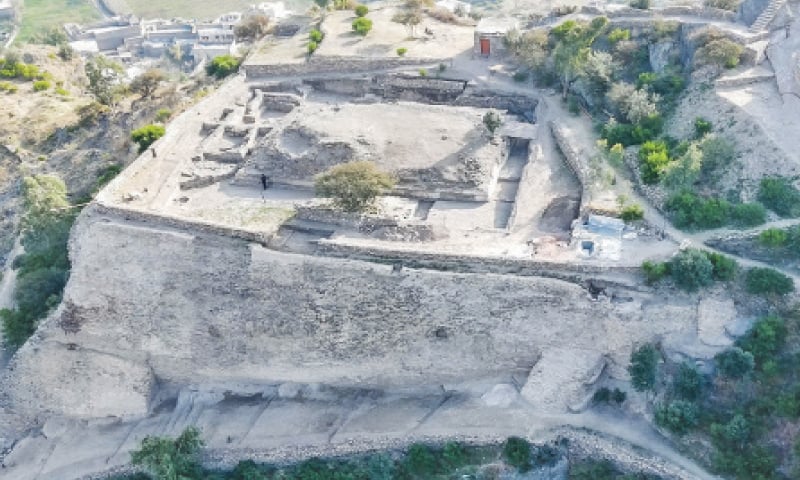
SWAT: The international archaeologists and conservationists said here on Sunday that the north-eastern fortification wall of Bazira city would be completely conserved through scientific techniques by next year as it was of great importance for the Gandhara region.
The conservation project titled “Saving the archaeological site of Bazira” was launched in April 2022 by the international alliance for the protection of heritage in conflict areas (Aliph) in collaboration with International Association for Mediterranean and Oriental Studies (ISMEO) and provincial department of archaeology and museums.
The project will focus on conserving the acropolis and creating a buffer zone and archaeological park on Ghwandai top in Bazira city.
Internationally recognised restoration and conservation expert Fabio Colombo, a member of ISMEO Italian Mission since 2011, is head of the activity. He also completed the restoration work at Jahanabad Buddha after the militants defaced it in 2007. Another renowned conservation expert Marco Pinelli from Accademia di Brera, Milan, Italy, who has been working with ISMEO Italian Mission since 2019, is part of the project.
Archaeologists term the project of great importance
Marco Pinelli, who is busy in working on the conservation, said that the conservation of the fortification wall started in April 2022. “In the beginning, the wall was in dilapidated condition. It was covered with vegetation while most of the stones were loose and falling down due to which it was fragile and on the verge of collapse,” he added.
He said that initially they started the conservation work from the north side of the Kushan-era retaining wall. “At first, we cleaned the wall and removed the loose rocks and replaced them with new and stronger ones. We have also exposed a big portion of the wall, which was buried in the soil. Using ancient techniques and materials, we have finished conserving the north side and started conserving the east side,” he added.
Prof Luca Maria Olivieri, head of the Italian Archaeological Mission, said that Bazira was one of the most important archaeological sites in Pakistan as it was inhabited from the 6th century BCE to the 14th century CE and contained many archaeological monuments of different civilisations.
“The multiphase and diverse history of Bazira city where we have evidence from the Bronze age till the medieval times make it one of the most important archaeological sites in Asia,” he said, adding that the huge fortification wall at the north and east side protecting Gwhandai top was in dilapidated condition.
“The fortification wall with huge bastions was a very important section of the upper part of Baizra, and its conservation was indispensable. Initially, the wall was constructed during the Indo-Greek period. The Kushan later reshaped it in the second century CE. Then it was repaired by the Hindu Shahi period in the 9th and 10th century,” he said.
Published in Dawn, December 12th, 2022