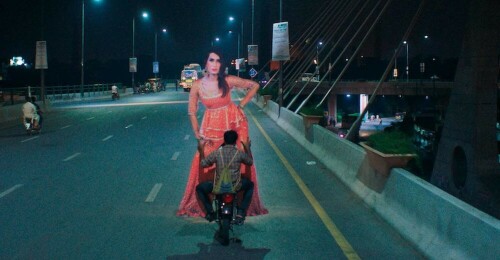
KARACHI: The Sindh High Court has ruled it is not the job of judiciary to morally police the public by deciding what should be or should not be viewed by them as unnecessary censorship suffocates a society and stifles its creativity and growth.
“In our view, where a cinematic work has passed through the censors, who have examined its content and cleared it for release with an appropriate certification, an individual cannot be allowed to trump that decision through a court proceeding based on his conception of morality. Indeed, it is not the function of the Court under Article 199 to make a moral judgment so as to curtail the freedom of speech and expression of a filmmaker, as safeguarded under Article 19 of the Constitution,” stated the detailed order passed by a division bench dismissing a petition seeking ban on the film Joyland.
The bench, headed by Chief Justice Ahmed Ali M Shaikh, added: “On the contrary, the default position of the Court under Article 199 ought to be that of fully safeguarding the fundamental right by giving as expensive an interpretation to Article 19 as possible, and in that event of a restriction being imposed by the Board or any other authority that may be competent in that regard, testing the reasonableness of that restriction stringently, so as to ensure that the same is “reasonable” in the strictest conceivable sense.
“As such, in the absence of any restriction imposed by the concerned quarter, whether that be the Board of Provincial Government, it does not fall to the Court to morally police the public by making a determination of what should or should not be viewed and to take on the function of itself devising and imposing a restriction. Suffice it to say that unnecessary censorship suffocates a society and stifles its creativity and growth”.
Detailed order dismissing plea for ban on Joyland says transgender persons are equal citizens of Pakistan in all respects
“Looking to the matter at hand, we are confident that Islam, being the great global religion that it is, is strong enough to withstand a cinematic work portraying a purely fictional account of a relationship humanizing a transgender character, and are equally sanguine that our society is not so weak as to crumble as a consequence,” the order stated.
“Suffice it to say that transgender persons are equal citizens of Pakistan in all respects and the stories of their life, their struggle, and their human relationships deserve equal space and recognition,” the court order concluded.
The petitioner sought a ban on the film, arguing that it apparently portrayed a relationship between a married man and a transgender woman, and averred that the storyline violates the Islamic teachings and the Constitution.
However, the judges observed that the petitioner did not make any attempt to show how any Articles would be violated by the screening of the film, other than confined his argument to the extent that the theme and storyline thereof offended the Article 277.
The bench noted that the petitioner did not directly challenge the certification of the film or even referred to the Sindh Motion Pictures Act, 2011 or impleaded as party the Board mandated to certify films for exhibition in the Sindh province under the 18th Amendment. Nor was it even remotely alleged that the statue offends the aforementioned Article, they added.
Published in Dawn, November 26th, 2022