0
0

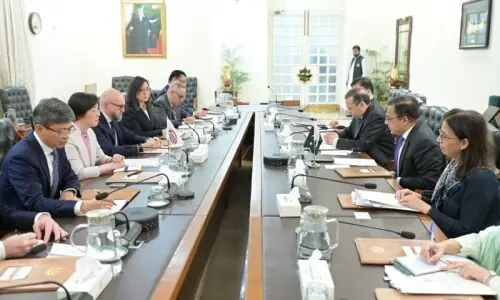
LAHORE: A workshop on calligraphy and Sufi music evening were main features on the second day of the International Islamic Art Festival at the Alhamra Art Centre, The Mall, on Friday.
Scholars read out papers on various topics at the conference being held here by the Lahore Arts Council and the Pakistan Arts Council, Karachi. The four-day event being marked in pursuance of Unesco’s dedication of Nov 18 to the Islamic art festival will conclude on Sunday (tomorrow).
Intellectuals and artists from Pakistan, Turkey, Saudi Arabia and Iran are participating in the festival. The historical journey of 1,400 years of Islamic sciences and arts is being celebrated through seminars, exhibitions, workshops, Qawwali programmes, bookstalls and other activities.
Calligraphists from Pakistan, Turkey and Saudi Arabia are participating. An exhibition of Islamic art having rare manuscripts of the Holy Quran, Quranic illuminated pages, art pieces of old masters and artworks by established artists are on display.
At a session, ‘Framework of Aesthetics’, which was moderated by Dr Sumera Jawad, Principal College of Art and Design, University of the Punjab, the speakers discussed various aspects of aesthetics in the Islamic art. Prof Dr Mamoona Khan, chairperson Fine Arts Department, Fatima Jinnah University for Women, Islamabad read out the paper on ‘Human and Humanism, Conceptions and Misconceptions on Muslim Aesthetics’. She threw light on theories of Muslim and non-Muslim thinkers. She also discussed Plato’s theory of creation. She dilated upon the concept of Wahdat and Wajood and showed a number of miniature paintings during her lecture.
She said the Islamic art should be perceived not only through eyes but also through heart.
Rabiya Asim from the National College of Arts spoke on the topic, ‘Silent Theology in Sacred Islamic Art of Quranic Illumination’, sharing concepts and developments in the Islamic civilisation and the Persian influence with the audience. She also discussed geometrical patterns, decorative ornaments and aesthetic significance of beauty. She discussed the philosophy of illumination.
Prof Davud Bektas from the University of Istanbul, Turkey shared his experience of carving calligraphy at a mosque in Turkey. He showed a number of slides which depict his calligraphy work.
Prof Rizwan Azeem read out a paper on ‘Architectural Calligraphy in Lahore, A Historical and Artistic Analysis”.
Earlier, at the first session, Dr Amjad Waheed, Taimoor Khan Mumtaz, Prof Dr Naela Amir, and Zaki Al Hashmi spoke. The study of Islamic arts, the reality of Islamic architecture, the renaissance of Islamic architecture in the subcontinent, and the process of promoting Islamic concepts in calligraphy were thoroughly discussed. The session was moderated by Dr Rahat Naveed Masood.
At the end of the festival’s second day, famous Qawwal Sher Miandad enthralled the people with his dynamic performance.
Along with the conference, a workshop titled “Art of Ebru Turkish Tradition” by Dogan Cagan and a workshop titled Persian Calligraphy via Zoom by Dr Kazim Khurasani from Iran took place.
Published in Dawn, November 19th, 2022