Govt launches Rs40bn uplift scheme for 20 poor districts

ISLAMABAD: The Ministry of Planning has launched a special development initiative worth Rs40 billion for 20 backward and poor districts to implement various uplift initiatives in 60 months in four provinces.
The estimated cost of this project is on a 50:50 cost-sharing basis between the federal and provincial governments. The project is approved by the Central Development Working Party (CDWP) headed by Planning Minister Ahsan Iqbal.
In PSDP 2022-23, an amount of Rs18bn has already been allocated for the project.
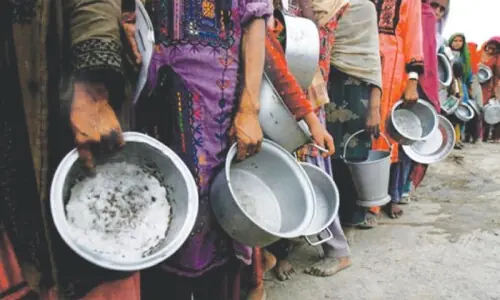
Based on Multidimensional Poverty Index (MPI) scores, the selected 20 districts include 11 districts from Balochistan, five from Sindh, three from Khyber Pakhtunkhwa and one from Punjab. Many of these districts have been direly affected by the recent flood disaster, especially in Balochistan and Sindh.
Areas selected based on poverty index scores
The 11 districts in Balochistan include Sherani, Kohlu, Jhal Magsi, Barkhan, Killa Abdullah, Zhob, Musakhel, Dera Bugti, Jaffarabad, Ziarat and Killa Saifullah. Five in Sindh — Sujawal, Thatta, Tharparkar, Kashmore and Badin and three in Khyber Pakhtunkhwa — Torghar, Shangla and North Waziristan and one district of Rajanpur in Punjab.
The tentative interventions in these districts will be in the areas of connectivity through roads, access to broadband services and internet, solarisation of off-grid areas, the establishment of LPG terminals, development of agri-livestock and mineral value-chain, tunnel framing, dairy farming, fish farming, etc, the establishment of common border markets, investments in skill development and scholarship for students.
Moreover, the federal government and provincial government will identify sub-projects based on in-depth assessment for identifying the local needs of the marginalised population. The respective forums at the federal and provincial levels will approve these projects. The sub-projects will be monitored through steering committees at the federal and provincial levels.
“This is the first of its kind project in the economic history of Pakistan where the federal government is undertaking a national intervention to uplift the poorest districts and address the disparity in economic development,” said the planning minister in a statement released on Saturday.
In the year 2017-18, the MPI survey was completed with the help of the United Nations Development Programme, which for the first-time mapped poverty at district levels across the country.
The main objective of this project is to promote inclusive growth and equitable development through targeted investments in infrastructure and human capital development in the poorest districts of the country. Investments in human capital development, especially for young people and women, are among the primary pillars of the project.
Based on Pakistan’s MPI estimation (2017-18), 38.3pc of the population in Pakistan (87,089,000 people in 2020) is multidimensionally poor while an additional 12.9pc is classified as vulnerable to multidimensional poverty (29,353,000 people in 2020).
Aligned with Pakistan Vision 2025 and the Global Agenda for Sustainable Development Goals 2030, the project aims to make a significant contribution toward reducing regional inequality and strengthening national integration and harmony in the country.
The project is part of the Youth Development Programme launched by Prime Minister Shehbaz Sharif last month.
Published in Dawn, November 13th, 2022