Imran should have taken part in debate on NAB law: judge


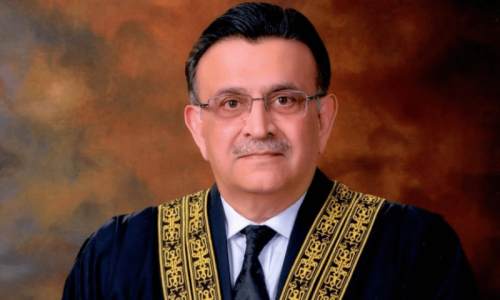
ISLAMABAD: Justice Syed Mansoor Ali Shah of the Supreme Court said on Monday that PTI chief Imran Khan should have taken part in a debate in parliament on the accountability law amendment bill instead of leading his party out of the legislature.
Justice Shah made the remarks during the hearing of a petition by the former prime minister challenging the amendments carried out in accountability laws in August.
The judge spoke about a “filtration system” in politics where a political party is voted out of office if it rams a bad law through parliament.
“This is how the law evolves and the political system works,” observed Justice Shah, a member of a three-judge Supreme Court bench headed by Chief Justice of Pakistan (CJP) Umar Ata Bandial.
Justice Shah wondered how the judiciary came into the picture to “second judge the wisdom” of parliament, which can give exemption to any law, e.g. the one on fiscal policies.
The legislature must have thought about redesigning the National Accountability Bureau (NAB) law because changes were necessary for improving the economy, the judge observed.
The observation came when senior counsel Khawaja Haris Ahmed, representing the PTI chief, termed amendments in the NAB law an eyewash since these changes had made it impossible to prove the charge of corruption against an accused.
Through the provision of mutual legal assistance, the counsel argued, Pakistan can approach any country to secure evidence of corruption against an accused, but evidentiary value or the admissibility of evidence can only be done by adopting a different forum when the evidence coming from abroad was equally good.
Justice Ijazul Ahsan said had parliament debated the draft law before adopting it, “we could have learnt about the real objective behind amending the law”.
An argument being developed by the counsel, added Justice Ahsan, was that the amended law had taken care of the state’s international obligations, but on the other hand a number of clauses had been softened only to benefit a certain class.
The counsel cited the United Nations Convention against Corruption 2003, to which Pakistan was a signatory, in an attempt to establish that the convention had a persuasive effect, but through the latest amendments the ruling coalition had done away with the essence of the convention.
International treaties
Justice Shah said the country’s legal code was ill-equipped to implement international conventions and wondered could the court give any directive to the government to make a law to match some international treaties. “It is a moot question whether the state is obliged to follow such directives.”
Justice Shah said it was debatable whether the NAB law was compliant with international treaties before the amendment.
Chief Justice Umar Ata Bandial observed that an international treaty represents a universal model, but a domestic law could exceed it in the harshness of a punishment.
Certain requirements need to be satisfied under an international treaty by making the domestic law compatible with it, the CJP added. “Otherwise it is all cosmetic.”
But no minimum standard is binding on parliament, the CJP added.
Khawaja Haris Ahmed pointed out, however, that such standards were indeed binding on the legislature, recalling the Bank of Punjab case in which Rs9 billion was squandered, but it was only after the apex court had taken suo motu notice that the National Accountability Bureau sprung into action. “The matter was pending with NAB since long, but it took no action.”
Even if a party had entered into a plea bargain with NAB to return the Rs9 billion after paying an instalment of Rs1 billion, the latest amendment meant that all the money would go to waste “since the government won’t get anything from it”, the counsel argued.
Justice Shah asked the counsel to name any country where laws were closest to international conventions. But the latter expressed his inability to do so.
“However one thing goes in our favour. The world came to know about the menace of corruption as late as 2003, whereas Pakistan had realised this way back in 1947 since we have had corruption laws since then,” Justice Shah quipped.
Published in Dawn, October 25th, 2022