LAUREL: Nasa’s DART spacecraft successfully slammed into a distant asteroid at hypersonic speed in the world’s first test of a planetary defense system, designed to prevent a potential doomsday meteorite collision with Earth.
Humanity’s first attempt to alter the motion of an asteroid or any celestial body played out in a Nasa webcast from the mission operations center outside Washington, DC, 10 months after DART was launched.
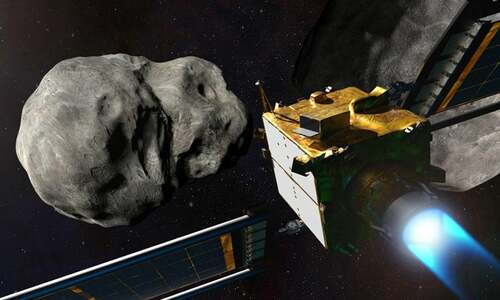
The livestream showed images taken by DART’s camera as the cube-shaped “impactor” vehicle, no bigger than a vending machine with two rectangular solar arrays, streaked into the asteroid Dimorphos, about the size of a football stadium, some 11 million kilometres from Earth.
The $330 million mission, some seven years in development, was devised to determine if a spacecraft is capable of changing the trajectory of an asteroid through sheer kinetic force, nudging it off course just enough to keep Earth out of harm’s way.
Whether the experiment succeeded beyond accomplishing its intended impact will not be known until further ground-based telescope observations of the asteroid next month. But Nasa officials hailed the immediate outcome of Monday’s test, saying the spacecraft achieved its purpose.
“Nasa works for the benefit of humanity, so for us it’s the ultimate fulfillment of our mission to do something like this — a technology demonstration that, who knows, some day could save our home,” Nasa Deputy Administrator Palm Melroy, a retired astronaut, said minutes after the impact.
DART, launched by a SpaceX rocket in November 2021, made most of its voyage under the guidance of Nasa’s flight directors, with control handed over to an autonomous onboard navigation system in the final hours of the journey.
Monday evening’s bullseye impact was monitored in near real time from the mission operations center at the Johns Hopkins University Applied Physics Laboratory in Laurel, Maryland.
Cheers erupted from the control room as second-by-second images of the target asteroid, captured by DART’s onboard camera, grew larger and ultimately filled the TV screen of Nasa’s live webcast just before the signal was lost, confirming the spacecraft had crashed into Dimorphos.
The mission represented a rare instance in which a Nasa spacecraft had to crash to succeed. DART flew directly into Dimorphos at 15,000 miles per hour, creating the force scientists hope will be enough to shift its orbital track closer to the parent asteroid.
APL engineers said the spacecraft was presumably smashed to bits and left a small impact crater in the boulder-strewn surface of the asteroid.
The DART team said it expects to shorten the orbital path of Dimorphos by 10 minutes but would consider at least 73 seconds a success, proving the exercise as a viable technique to deflect an asteroid on a collision course with Earth, if one were ever discovered. A nudge to an asteroid millions of miles away years in advance could be sufficient to safely reroute it.
Earlier calculations of the starting location and orbital period of Dimorphos were made during a six-day observation period in July and will be compared with post-impact measurements made in October to determine whether the asteroid budged and by how much.
Published in Dawn, September 28th, 2022