Life turns into misery for occupied Kashmir’s Bakarwal tribe

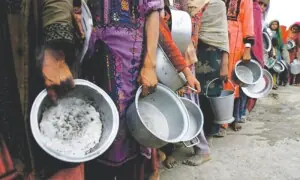
KARACHI: In India-occupied Kashmir, a nomadic tribe is struggling to maintain its traditional lifestyle in the face of changing forest landscapes and weather conditions.
“People try to paint a rosy picture of our life but ours is, in fact, a saga of endurance and miseries,” says Liaquat Khan, a shepherd from the Bakarwal tribe, in an interview with the BBC.
The Bakarwals are part of a 3.4 million-strong nomadic community in the region whose primary occupation is rearing cattle.
At 55km from Srinagar, they camp in Dardwodur forests.
Nazira, 30, is a skinny mother cradling her new-born here. Her tribe arrived three days ago and camped on the alpine heights.
“It’s time for us to start winter migration,” Nazira says, as she sticks her head out from her makeshift tent.
For years, the Bakarwal tribe has been shuttling between India-occupied Jammu and Srinagar valley. They arrive in the valley in April and spend six months during the summer. By October, they return to the plains of Jammu for the winter.
“We belong to nowhere,” says Zulfi, a young Bakarwal girl. “This is just our summer home.”
The Bakarwals were officially declared as a “scheduled tribe” — tribal communities recognised by India’s constitution as socially and economically disadvantaged — by New Delhi in 2001.
Today, the tribe fears for the endurance of its traditional lifestyle due to increased wild animal attacks on their cattle — their main source of income.
Sale of their livestock has also dwindled.
“Earlier, a day of hard work would fetch a good amount of money for a sheep or a goat but not anymore,” says Mohammed Zubair, 50, a disabled nomad camped on the outskirts of Srinagar.
The community also struggles with increased instances of inclement weather. “It’s extremely difficult to travel to the high altitude pastures of the Himalayas,” says Liaquat Khan, a shepherd.
In June, unseasonal snowfall and severe cold weather conditions in Chenab valley left hundreds of tribal families stuck on road sides, with little food or fodder.
Another major concern for the tribe is their access to forest lands.
Last year, hundreds of families from the community were served eviction notices for “illegally” occupying forests which they have lived in for decades. Authorities also demolished several houses — the community lives in temporary tents and mud huts in these areas.
A few months later, however, Lieutenant Governor Manoj Sinha said authorities would work to safeguard the rights of tribal communities in the region and provide them with rights certificates.
Focus on education
The harsh realities of their current existence are pushing the tribe’s younger generation to focus on getting a good education and living an easier life.
The administration has also set up community schools to educate children of such tribes in forest areas.
Despite various kinds of pressures on the community, many say they are determined to stick to their traditional lifestyle.
“We aren’t giving up on anything,” says Zulfi. “Although we are uncertain about our lives, we are firmly holding on to our traditions, no matter what.”
Published in Dawn, September 24th, 2022