Starving flood victims face infectious diseases under open sky in Sindh



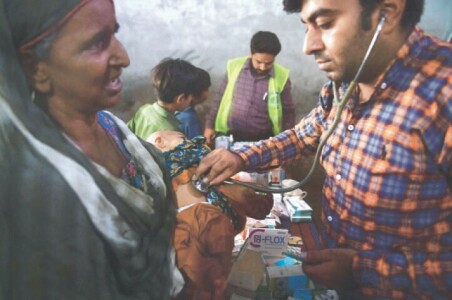
KARACHI: An alarming situation currently prevails in the flood-affected areas where hundreds and thousands of flood-affected people, often forced to live under the open sky, are grappling with hunger and disease, it emerged on Sunday.
According to the latest July-Sept health department data, 660,120 have reported various illnesses at government-run medical camps in flood-affected areas since July.
The stats show that skin ailments and diarrhoeal diseases are rampant in flood-affected areas — a total of 149,551 reported with diarrheal diseases while 142,739 people reported with skin infections.
The officials recorded 132,485 cases of acute respiratory disease, 49,420 cases of suspected malaria, 101 cases of snake-bite and 550 cases of dog-bite.
Govt data says over 600,000 people report with various illnesses at medical camps
There were 185,274 cases of other illnesses.
In an interview on Sunday, Health Minister Dr Azra Fazal Pechuho stated that over 47,000 pregnant women were in shelter camps in the province.
Read: Healthcare during floods
Hundreds and thousands of people had contracted various diseases after the floods, she added.
According to officials, over 15,000 cases of skin infection cases, around 14,000 cases of diarrhoeal diseases and more than 13,000 cases of acute respiratory illnesses are being reported daily at government-run medical camps.
Numbers much higher
Workers engaged in relief efforts in the flood-hit districts, however, believed that the actual number of cases was much higher as there were still several places in the province where the government was yet to reach and start relief operations.
“One of the major challenges currently being faced in the disaster areas is lack of shelter. Today, we have visited Mirpurkhan, Tando Muhammad Khan and Tando Adam but couldn’t see a single government-run relief camp and people were forced to live under the sky,” Dr Abdul Ghafoor Shoro, secretary general of Pakistan Medical Association-Karachi said.
One relief camp the team came across was being managed by the People’s Primary Health Care Initiative on the Khipro road, he added.
“Skin infections are common as the vast majority of people had remained exposed to water for 10 to 15 days. The flooded areas are now breeding grounds for mosquitos but the people neither have shelter nor mosquito nets.”
The situation, Dr Shoro feared, would aggravate in the coming days and there was an immediate need for urgent action.
“People living under the open sky are forced to drink contaminated water. They are getting little bit of food either from non-profit organisations or some kind-hearted landlords.”
According to health department officials, around 5m people have been displaced in the devastating floods, which damaged over 1,000 health facilities in Sindh.
Of them, 966 were partially damaged whereas 126 were completely destroyed.
Editorial: Health catastrophe
The highest number of partially damaged facilities were located in Sukkur (230) followed by Larkana (199), Hyderabad (183), Mirpurkhas (171), Shaheed Benazirabad (156) and Karachi (27).
Mirpurkhas lost 65 health facilities followed by Hyderabad 22, Sukkur 17, Larkana 13, Shaheed Benazirabad 7 and Karachi 1.
The government data shows that while the cases of cholera were on the decline, cases of diarrhea and dysentery are increasing in Sindh.
“There are 293 mobile camps and 157 fixed camps where 496 doctors and 1138 paramedics have been assigned duties,” the data says.
Published in Dawn, September 5th, 2022