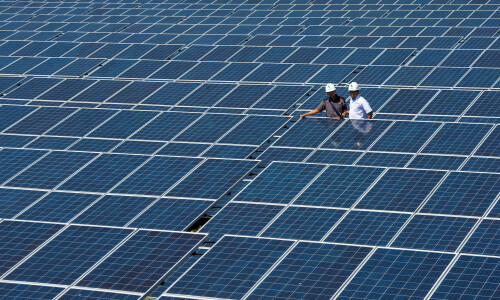
KARACHI: Pakistan’s entire energy demand can be met by taking advantage of only 0.07 per cent of the country’s solar potential.
Speaking at the First Annual State of Renewable Energy Conference on Thursday, Sustainable Development Policy Institute (SDPI) Executive Director Dr Abid Q Suleri said the country must cultivate renewable sources of energy after assessing the policy trade-offs.
“Fossil fuels are key drivers of climate change. We’ve witnessed their impact in the form of heatwaves and floods,” he said in his inaugural session at the conference, which was organised by the SDPI’s Network for Clean Energy Transition in collaboration with GIZ, Unilever Pakistan, Energy Update, Stimulus, and Renewables First.
Explaining the country’s renewable energy generation potential, SDPI’s Research Fellow Dr Hina Aslam said Sindh and Balochistan can produce 340 gigawatts of wind-generated electricity, adding that recycling 30 million metric tonnes of municipal solid waste annually should also be exploited to produce energy from waste.
Pakistan experienced a 3.25pc increase in renewable energy in 2021 while net foreign direct investment in the power sector was $911.7 million.
Additions of renewable energy capacity to the power system are slow in Pakistan. About 200 megawatts of solar- and 750MW of wind-based electricity have been commissioned (or added) in 2022. As a result, the total installed capacity of solar and wind energy is currently 600MW and 1,985MW, respectively, according to the Annual State of Renewable Energy Report Pakistan released on Thursday.
In terms of the tariff determination of renewables, Dr Aslam said the current cost of generation from different sources shows renewables were becoming increasingly competitive with conventional fossil fuel–based sources.
The current generation mix includes wind and solar with much higher older tariffs of Rs25.25 per kWh and Rs24.41 per kWh as well as the latest plants whose tariff is as low as Rs16.20 per kWh and Rs19.14 per kWh. The tariff determined by the power sector regulator for wind plants in the last decade has come down from Rs12.77 per kWh to Rs6.39 per kWh.
She said a transition towards a 100pc renewable energy system is not only fully possible but also a low-cost option, which will help decrease the energy system costs while reducing national dependence on imported fossil fuels.
Speaking on the occasion, Alternate Energy Development Board CEO Shah Jahan Mirza said the board is launching a large-solar power project with the capacity of 2,400MW with the government providing three sites to private power companies.
K-Electric Ltd Chief Strategic Officer Naz Khan said her company plans to add 1,200MW from renewable energy in the next seven to eight years. As many as 637MW were generated and 519MW were commissioned on net metering of domestic consumers in June 2022, she added. Incentives should be extended through cost-reflective tariffs and competitive bidding to attract investment to renewable energy, said Ms Khan.
Published in Dawn, September 2nd, 2022