ISLAMABAD: As the controversy about the July 28 session of the Judicial Commission of Pakistan (JCP) refuses to die down, a senior member representing the premier Pakistan Bar Council (PBC) believed the issue would not have cropped up if the meeting had not been ‘abruptly terminated’ and a formal vote and final decision were recorded in the minutes at its end.
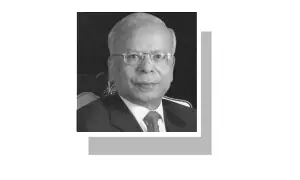
Under all circumstances, it was essential that JCP meetings ended with a formal vote taking, as it was entirely possible that one or more commission members might change their minds after listening to their colleagues, senior JCP member Akhtar Hussain wrote in a four-page letter on Friday to Chief Justice of Pakistan Umar Ata Bandial, who heads the commission.
This was a fifth letter to Chief Justice Bandial in a week about the JCP meeting, after Justice Qazi Faez Isa, Justice Sardar Tariq Masood, Attorney General for Pakistan Ashtar Ausaf and Justice Sajjad Ali Shah had expressed their concerns.
While emphasising that the fierce and evident division that cropped up within the judicial institution was not in the national interest, Mr Hussain regretted that the blame of this division could be rested at many doors, but added that the solution lay, first and foremost, at the doors of the CJP as the head of the legal fraternity of Pakistan. “Even otherwise on a personal level, your lordship’s calm and unfailingly courteous disposition makes you best suited for the onerous task of once again uniting our fraternity,” the letter said, adding: “Let that be your legacy.”
PBC representative writes to CJP about ‘controversial’ July 28 meeting
Mr Hussain highlighted that the only solution to avoid factionalism, which was unfortunately prevailing, was to amend the JCP rules and frame more objective, transparent and measurable criteria and processes for the nomination and appointment of judges.
The senior counsel recommended that the rule-making committee of the commission be activated under the chairmanship of a senior puisne judge as per past practice, with a clear mandate to solicit the views of all stakeholders and thereafter devise draft rules and criteria for appointments for the approval of the commission within four weeks.
In the past few meetings of the commission, and especially the last one, there is a clear consensus among a majority of the commission members to amend JCP rules, the letter reminded, adding there was a clear majority for adhering to seniority principle. Until this process was completed, all commission members should be allowed to propose nominees for appointment rather than the CJP alone.
This must be treated as a decision of the commission and implemented accordingly rather than needlessly making alternative nominations, which are then not approved as has happened on the last three occasions, according to him.
The member also expressed regret over Justice Sajjad Ali Shah’s observations and said certain discussions that took place in the JCP had the effect of harming the reputation of the judges concerned. He said it was exactly for that reason deliberations of the commission were confidential — to strike a balance between the desire for a free and frank exchange of views regarding candidates whilst protecting the reputations of those being discussed.
It was all the more necessary to consult all commission members before deciding to release the audio recordings in relaxation of the rules, he reasoned.
Perhaps, had such consultation been held, it would have been possible to issue a consensus minutes of the meeting, recording the exact positions of the members in majority and minority without delving into “unnecessary details and leaving no need for issuance of the audio record”, the JCP member said.
In the first place, he said, writing of such letters and the issuance of press releases and audio proceedings of the JCP should not have been necessary. If the July 28 meeting had not been abruptly terminated and a formal vote and final decision had been recorded in the minutes at the end of the meeting, this occasion would not have arisen, he added.
In view of the disquiet being expressed within the judiciary, the bar and public in general, the time has come to accept at least some limitations and restrictions in our discretion, Mr Hussain said. “Since the day I have become a member of the commission; I have been emphasising that our proceedings and decisions should be a deliberative, collective and collegiate exercise,” the JCP member said.
“We must not divide ourselves in camps nor treat the commission’s decisions as an internal election. We must neither seek to rush through our favoured candidates when we feel we are in the majority nor seek to unnecessarily postpone when we feel we are in minority,” he said.
Published in Dawn, August 6th, 2022