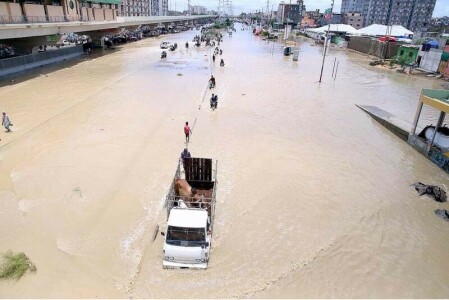
THIS year’s monsoon rains have taken a heavy human toll across the country due to flash floods and urban flooding. Around 150 people have been killed in rain-related incidents over the last month, with Balochistan hit particularly hard. Over 60 rain-related fatalities have been reported since June in the province.
Sindh has not fared much better, with the Provincial Disaster Management Authority saying at least 26 people have been killed in rain-related incidents across the province, with most fatalities reported from Karachi.
Unfortunately, flooded roads and homes, the fear of electrocution and life coming to a standstill are the usual outcomes of even moderate rainfall in Pakistan’s largest city. This year’s monsoon, with consistent rainfall recorded in the city over the last week or so, has lived up to the pattern.
Precipitation over the weekend into Monday resulted in flooded thoroughfares, with the city’s Keamari and East districts receiving the most rainfall, and areas from Clifton and Defence in the south of Karachi up till its northern fringes all facing urban flooding.
Various reasons are being cited for Karachi’s annual monsoon disaster. These include climate change and heavier-than-usual rains; official incompetence; encroachments and lack of planning. Perhaps it would not be wrong to say that a combination of factors is responsible for the havoc.
Read: Karachi's crumbling infrastructure has made rain a bane for its residents
The heavy rainfall in 2020 had prompted all arms of the state to look into solving this key problem in the country’s commercial heart. The then prime minister announced a Rs1.1tr package to ‘transform’ the city; the Supreme Court ordered encroachments around drainage channels to be removed, while the provincial government also swung into action.
Two years down the line, not much has changed, and clearly, the civilian administration and those managing DHA and the cantonment areas have learnt few lessons from past disasters. While it is true that Karachi has suffered from decades of official neglect at the federal, provincial and local levels, there needs to be a concerted effort from official quarters to resolve the urban flooding issue permanently.
There is an argument that even better developed cities struggle with urban flooding. While that may be correct, it cannot be an excuse to abandon Karachi, and allow the grim annual ritual of rain-related death, dislocation and destruction to be repeated ad infinitum.
Urban planners and topography experts — local or foreign if need be — should be consulted by the state to chart out a plan to minimise the risks of flooding, and their recommendations need to be implemented in earnest.
The Met department has forecast more heavy rain in the days ahead. The administration needs to have contingency plans ready to better tackle the coming wet weather, while without an improved drainage and urban disaster response mechanism in the long term, the people of Karachi will be left to face the gushing floodwaters on their own.
Published in Dawn, July 13th, 2022