TUESDAY’s suicide bombing at the Karachi University may be the harbinger of a new and unexpected dimension in the dynamics of terrorism in Pakistan, particularly the Baloch insurgency.
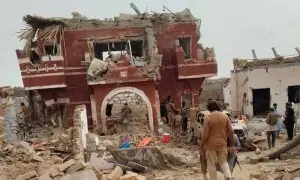
It was appalling enough that a suicide bomber had targeted the faculty of the Confucius Institute on campus, killing three Chinese nationals and their Pakistani driver on the spot. But the shock was further compounded when the identity of the attacker came to light. Less than an hour following the incident, the banned Baloch Liberation Army took to social media to claim responsibility and announce that the bomber was a woman named Shaari Baloch.
Details emerging later revealed her to be a highly educated mother of two young children, belonging to a well-established family and working as a school teacher in her native Turbat, Balochistan. Moreover, it appears that no one in her close family was missing or had ever been forcibly disappeared — all of which adds up to an unlikely profile for a suicide bomber. It does, however, suggest that the insurgency is evolving in a direction that makes it imperative for the authorities to revisit their approach to it.
Suicide attacks, which involve an implicit belief in a reward in the afterlife for the act of ‘self-sacrifice’, have almost always been the preserve of religious extremist groups, with some notable exceptions such as Sri Lanka’s Tamil Tigers. Much like the latter, the Baloch insurgency too is based on a secular ideology, and the KU bombing is among few such attacks perpetrated by the separatists.
Read: Women suicide bombers
The phenomenon of female suicide bombers is also rare in Pakistan, and except for the very first instance in the 1980s — the details of which remain unknown — three other such attacks, in 2010 and 2011, were claimed by the TTP. For a woman like Shaari Baloch to choose to go down this route despite her not disadvantageous circumstances is significant, and speaks to an increasing frustration in Baloch society.
Enforced disappearances, profiling of Baloch students at university campuses, the province’s lack of agency over the proceeds of its natural resources, etc have exacerbated the yawning deficit between the people and the state. That combined with increasing access to information via social media and deeper engagement in nationalist discourse has seen young Baloch become less reticent about expressing their anger and resentment, even in interactions with the military’s senior leadership. It is a critical point in time.
That said, to attack soft targets is utterly reprehensible. And for teachers to be singled out, as happened in the latest instance, is all the more surprising given that the current insurgency is distinguished from its previous iterations by the fact that its support base largely comprises educated young Baloch.
For there to be any possibility of peaceful coexistence, the Baloch must shun such acts of senseless violence and the authorities reach out to them.
Published in Dawn, April 28th, 2022