14
14

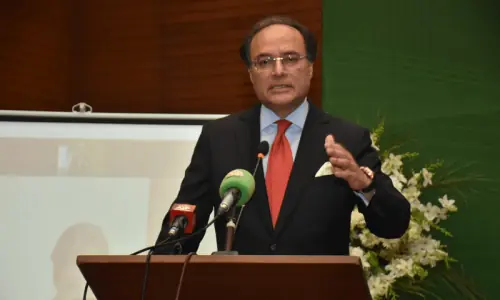
WASHINGTON: Finance Minister Miftah Ismail returned to Pakistan on Monday after negotiating a deal with the International Monetary Fund (IMF) that may give some space to the new government to make a “people friendly” budget in June.
But an IMF statement issued after the talks indicates, the deal does not equip the government with the tools it needs to clear, what Mr Ismail described as, “the landmines planted” by the PTI government, i.e., facing the consequences of withdrawing fuel subsidies given by his predecessors.
“We had very productive meetings with the finance minister … over Pakistan’s economic developments and policies under the Extended Fund Facility (EFF) program,” the IMF said.
“We agreed that prompt action is needed to reverse the unfunded subsidies which have slowed discussions for the 7th review.”
Miftah hints at withdrawing Rs21 per litre subsidy on petrol, besides further increasing fuel prices
Mr Ismail responded to the IMF in a tweet, thanking the Fund’s “management and staff for their cooperation in reviving a fiscally responsible economic development strategy for Pakistan”.
In 2019, the IMF approved a $6 billion loan for Pakistan but concerns about the pace of IMF-mandated reforms have delayed its disbursements, although half of this amount has been disbursed.
The IMF completed the 6th review of the programme in February, which led to the disbursement of $1bn to Pakistan. Pakistan has asked the IMF to enhance its bailout package from the remaining $3bn to $5bn.
The IMF said that Pakistan has also requested the extension of the loan arrangement through June 2023 “as a signal of their commitment to address existing challenges and achieve the program objectives”.
The IMF “expects to send a field mission to Pakistan in May” to resume discussions over policies for completing the 7th EFF review, the statement added.
On Sunday afternoon, the finance minister told journalists in Washington that technical level talks on Pakistan’s proposal will start from Tuesday.
Mr Ismail also hinted at two major issues that the new government would face this summer: increase in fuel prices and the excruciating load-shedding caused by Pakistan’s inability to buy enough fuel to run its power plants.
Mr Ismail only said that the government was “doing its best to avoid it”, when a journalist suggested that people could face from 6 to 12-hour long load-shedding this summer.
He also hinted that besides withdrawing the Rs21 per litre subsidy on petrol, the government could also increase the fuel prices even further.
The next elections are due in a year, forcing the ruling parties to face the unpleasant task of seeking votes soon after the load-shedding and the price hike.
At a talk on the Pakistani economy, a renowned Princeton economist Atif Mian highlighted some of the problems that the new government could face.
Top on the list was an $18 to $20 billion current account deficit that Pakistan will face by the end of the fiscal year in June.
Such large deficits, he argued, cause rapid devaluation as they make imports more expensive and lead to high inflations.
The deficit, he said, also forces the State Bank to increase domestic interest rates, as Pakistan did recently, which causes the domestic economy to contract.
Mr Mian noted that the previous PML-N government also faced a similar situation in its last year in power. He, however, pointed out that the Pakistani economy “has had 15 such episodes in the last 50 years”, Pakistan, he said, had an elite-captured economy where imports were twice as much as exports.
The finance minister also referred to this problem at his news conference, explaining how the poor were forced to subsidise fuel for the rich, who were saving as much as Rs1,600 every time they filled their tanks.
He emphasised the need to correct this “remarkable imbalance” but also acknowledged that such corrective measures take time to have an impact, and the current government does not have that.
The minister also was not sure if the relief he is seeking from the IMF would reach Pakistan before the government makes the new budget in June.
Published in Dawn, April 26th, 2022