PM for ‘doing all it takes’ to eradicate polio forever


ISLAMABAD / PESHAWAR: After Pakistan recently reported its first case of the wild poliovirus after a gap of 15 months, Prime Minister Shehbaz Sharif on Monday vowed to provide and utilise all available resources to eradicate the crippling disease from Pakistan permanently.
He was presiding over a high-level meeting on the eradication of polio from sensitive districts of the country. Federal Health Minister Abdul Qadir Patel, Information and Broadcasting Minister Marriyum Aurangzeb, provincial chief secretaries, deputy commissioners of the affected districts and other high-ranking officials also attended the meeting.
Last week, the National Institute of Health announced detection of poliovirus in a 15-month-old boy from North Waziristan — the first case in 15 months. It raised alarm as this was one of the only three cases detected worldwide this year — the other two being from Afghanistan and Malawi. The strain of the virus reported in Malawi was also traced back to Pakistan. However, Pakistani health authorities claimed the particular strain had not been detected in Pakistan since 2019.
On Monday, the prime minister directed to accord special focus to the districts of Khyber Pakhtunkhwa, including North and South Waziristan and Bannu, during the anti-polio campaign. He stressed ensuring administration of polio vaccine to the children who had been left out previously for some reason, adding the masses should be provided with the best possible medical services. Mr Sharif also advocated acknowledging as national heroes the deputy commissioners who performed well in the campaign.
Six-day vaccine drive begins in Mir Ali tehsil, North Waziristan, after virus detected last week
Southern Khyber Pakhtunkhwa had been identified by the polio eradication programme as the area most at risk after wild poliovirus was detected in its environmental samples in the last quarter of 2021. Positive samples of the virus had also been found in Dera Ismail Khan and Bannu divisions.
Pakistan had enjoyed 15 months without any polio case due to which Bill and Melinda Gates Foundation Co-Founder Bill Gates, earlier this year, praised the country’s polio programme as ‘inspiring’ during his maiden visit to Islamabad.
Pakistan remains one of the only two countries in the world with a circulating wild poliovirus, together with Afghanistan. Polio is a highly infectious virus and until this last remaining epidemiological bloc wipes out polio, children all over the world remain at risk of life-long paralysis or fatality because of it.
The wild poliovirus (WPV) types 2 and 3 have been eradicated globally, while cases of WPV1 are on a historic low, as only three have been reported across the globe this year.
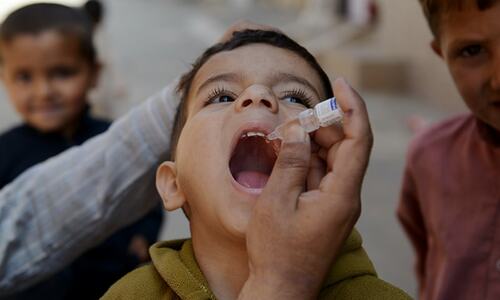
Meanwhile, authorities on Monday launched a six-day anti-polio campaign in Mir Ali tehsil of North Waziristan tribal district in response to the detection of a case last week.
“We have initiated a drive to inoculate children in the nearby union councils to interrupt circulation of the virus. Poliomyelitis has no cure; vaccination is the only way to prevent and eradicate it,” Dr Shamsur Rehman, the North Waziristan deputy district health officer, told Dawn.
He said 13,000 children under the age of five would be administered vaccines during the drive. According to him, those aged between two and five years will receive oral polio vaccine (OPV), while the inactivated polio vaccine (IPV) in injectable form will be administered to those younger than that, to scale up their immunity.
“We want to break the chain of the virus and interrupt its transmission. We have been requesting parents to cooperate with the workers and ensure a healthy future for their sons and daughters,” he stressed. Poliovirus invades the nervous system and can cause paralysis of arms and legs, and even death, he added.
Officials in the health department said the detection of the virus was a setback to the polio eradication programme, which was aimed at achieving a polio-free status for the country. Every country is required to avoid the virus for three consecutive years to be declared free, and Pakistan had reached close to that target on a few occasions, but couldn’t materialise its plans.
“More than 50 people have been killed allegedly by militants since 2012 in various anti-polio drives, mostly in Khyber Pakhtunkhwa which remained a hotspot of the virus for many years,” they said.
Published in Dawn, April 26th, 2022