THIS is with reference to the report ‘Senate adopts resolution in support of parliamentary form of govt’ (Feb 1) which talked about the resolution against some imaginary campaign for changing the form of government in the country.
No one has ever denied the fact that the 1973 Constitution envisages a federal parliamentary form of government in the country, and that the transition to a presidential form will require drastic amendments in it; may be the country will need an altogether new constitution. However, two main points of the Senate’s resolution require to be reconsidered by those who trumpet the parliamentary form as the most suitable for Pakistan.
The Senate resolution recalled that the Quaid-i-Azam envisioned a federal parliamentary form of government for Pakistan. It further recalled that “the people of Pakistan have relentlessly struggled and sacrificed” for a parliamentary system.
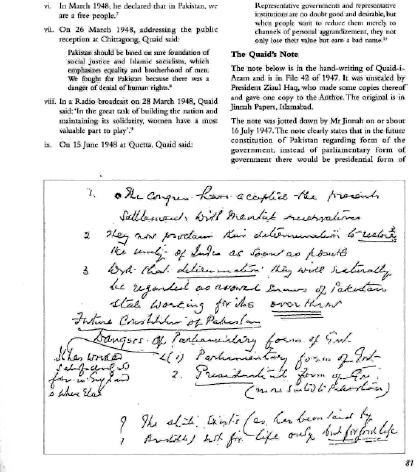
There is absolutely no evidence on record that the Quaid had ever preferred or supported the parliamentary form. On the contrary, there is possibly an authentic evidence that the Quaid believed otherwise.
While writing these lines, I have before me a book, The Jinnah Anthology, compiled and edited by Liaquat H. Merchant and Sharif Al Mujahid, and published by Oxford University Press, Karachi. On page 81 of the book, there is an image of a note (reproduced here) in the handwriting of the Quaid. The note, stated to be jotted down by him “on or about 16 July 1947”, clearly states that the “presidential form of govt” was “more suited to Pakistan”. I have checked some other books, too, and have found nothing in support of the Senate’s assertion.
I would recommend intellectuals and parliamentarians to read the aforesaid book, and would welcome if someone comes up with any recorded evidence to substantiate the Senate resolution.
The second part of the said resolution, about the supposedly relentless struggle and sacrifice of the people for a federal parliamentary form of government, is also not true. In a country where over 50 per cent of the registered voters do not care to cast their votes in general elections, it is not correct to say that the common man has ever struggled for a parliamentary form of government.
History tells us that an overwhelming majority of Pakistanis have always welcomed third-party interventions. From 1958 to the last such episode in 1999, the masses did not resist the way people in Myanmar and Sudan have done in the last couple of years. I do not personally see that a truly representative democracy — parliamentary or presidential — will ever take root in Pakistan because uneducated and uninformed people are swept away by personality and family cults.
Finally, the so-called presidential systems the country had in the past have nothing to do with a democratic presidential form of government. Besides, the presidential system in the United States has not caused any disastrous consequences since 1776.
It is a historical fact that most of those who said goodbye to the British parliamentary system were themselves former Britishers.
Shameem Ahmad
Karachi
Published in Dawn, February 17th, 2022