Nuclear scientist Dr Abdul Qadeer Khan given state funeral, laid to rest in Islamabad
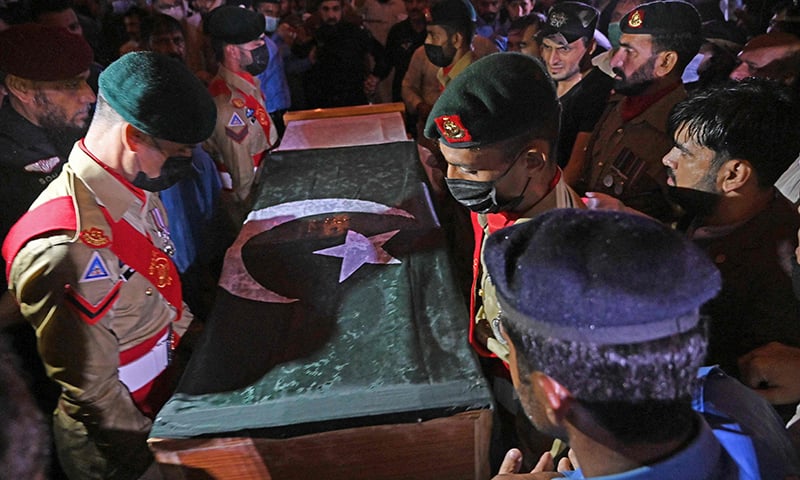


Nuclear scientist Dr Abdul Qadeer Khan passed away in Islamabad on Sunday morning at the age of 85. He was given a state funeral at Faisal Mosque before being laid to rest at the H-8 graveyard.
According to Radio Pakistan, he was admitted to a local hospital where his health deteriorated early morning. PTV said that he died after being transferred to a hospital with lung problems.
A large number of people, including cabinet members, parliamentarians and military officers, attended the funeral prayers.
Interior Minister Sheikh Rashid Ahmed earlier said that under the directions issued by Prime Minister Imran Khan, Dr Khan was given a state funeral.
Speaking to the media in Islamabad, he said that the premier had directed cabinet ministers to attend the funeral. The interior minister said that the Chairman Joint Chiefs of Staff Committee and the services chiefs would also be in attendance.
Rashid said two graves were prepared; one at Faisal Mosque and another at the H-8 graveyard. He later said his family decided that as per his will he would be buried at the H-8 graveyard.

"The whole nation is grieving," the minister said, adding that the flag would be flown at half-mast.
He said that he had also directed law enforcement agencies and the Islamabad commissioner to make security arrangements.
'National icon for Pakistanis'
Prime Minister Imran Khan said Dr Khan was loved by the nation because of his critical contribution in making Pakistan a nuclear weapon state.
"This has provided us security against an aggressive much larger nuclear neighbour. For the people of Pakistan he was a national icon," he said, adding that he would be buried in Faisal Mosque "as per his wishes".
President Dr Arif Alvi said that he had personally known Dr Khan since 1982. "He helped us develop nation-saving nuclear deterrence, and a grateful nation will never forget his services in this regard," he said.
Last month, Dr Khan had complained that neither PM Imran nor any of his cabinet members inquired after his health while he was under treatment at a hospital.
According to the state-run Associated Press of Pakistan, Dr Khan had been admitted to Khan Research Laboratories Hospital on August 26 after he tested positive for Covid-19. Later, he was shifted to a military hospital in Rawalpindi but was discharged after recovering from the virus.
'A huge loss for Pakistan'
According to a statement issued by the Inter-Services Public Relations (ISPR), Chairman Joint Chiefs of Staff Committee General Nadeem Raza and all services chiefs expressed sorrow over Dr Khan's passing.
The ISPR statement also quoted Chief of Army Staff General Qamar Javed Bajwa as saying that he had rendered invaluable services to strengthen Pakistan's defence capabilities.
Leader of the Opposition in the National Assembly Shehbaz Sharif said that the nation had lost "a true benefactor who served the motherland with heart and soul."
"The passing of Dr Khan is a huge loss for the country. His role in making Pakistan an atomic power remains central," he said.
Defence Minister Pervez Khattak said he was "deeply grieved" over his passing and called it a "great loss".
"Pakistan will forever honour his services to the nation! The nation is heavily indebted to him for his contributions in enhancing our defence capabilities," he said.
Planning and Development Minister Asad Umar said that Dr Khan had played an important role in making the country "invincible". He also offered prayers for the deceased.
Born in 1936 in Bhopal, India, Dr Khan had immigrated along with his family to Pakistan in 1947 after partition of the subcontinent.
He did a science degree at Karachi University in 1960, then went on to study metallurgical engineering in Berlin before completing advanced studies in the Netherlands and Belgium.
After learning of India's nuclear test in 1974, he had joined the nation's clandestine efforts to develop nuclear power. He had founded the Khan Research Laboratories in 1976 and was its chief scientist and director for many years, according to Radio Pakistan.
He was awarded the Nishan-i-Imtiaz for his services to the country.
In 2004, Dr Khan was at the centre of a massive global nuclear proliferation scandal. In a series of dramatic developments, he was accused by then army chief and president Pervez Musharraf of running a rogue proliferation network for nuclear material.
Shortly after Musharraf’s announcement, a recorded confession by Khan was aired in which he took sole responsibility for all the nuclear proliferation that had been revealed. He was subsequently placed under house arrest.
A court ended his house arrest in February 2009, but his movements were strictly guarded, and he was accompanied by authorities every time he left his home in Islamabad.
Later, he had filed a plea in the Lahore High Court seeking enforcement of his fundamental rights, including free movement. The LHC had rejected the plea in 2019 on the grounds that it lacked jurisdiction in view of special security measures adopted by the state.
He had then moved the Supreme Court against the LHC's decision, which had asked the attorney general to meet the nuclear scientist and allay his concerns.