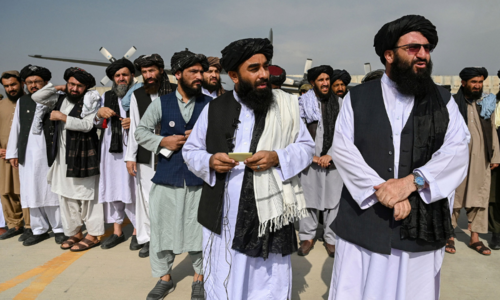
THE blame game with regard to the Afghan Taliban’s stunning takeover in Afghanistan has gone a step beyond rhetoric in the US corridors of power.
On Monday, a bill was moved in the US Senate seeking to impose sanctions “with respect to the Taliban and persons assisting the Taliban in Afghanistan”. It calls for a report on what transpired in the decades since the first Taliban government was ousted in 2001, the support extended by non-state and state actors — including the Pakistan government — to the insurgent group, the fall of the Ashraf Ghani government and the Taliban offensive in Panjshir Valley.
The precipitous collapse in August of the US-backed Afghan government was a humiliating coda to America’s longest war, and it was expected that the superpower would seek to deflect responsibility for its own policy failures onto other stakeholders. Pakistan’s unnecessary drum-beating about the Taliban victory is not helping its case either, and is in fact making the Western world nervous. Nevertheless, it is critical that more level-headed views on the matter prevail in the US legislature rather than those seeking punitive action.
Read: Blame game is on
The situation in Afghanistan is extremely delicate: skill and patience are required to extract from the Taliban something resembling even a modicum of respect for universal human rights. They are looking to the world to help their war-ravaged country which is in the throes of an economic meltdown. The announcement that the regime will “temporarily” and “with amendments” adopt the constitution of 1964 that ushered in nearly a decade of parliamentary democracy during King Zahir Shah’s reign indicates its desire to project the image of a legitimate government the world can do business with. But there are also signs of friction among the Taliban leadership, possibly between the hardliners and those somewhat ‘mellowed’ by diplomatic engagement with the international community.
It is essential for the world to strengthen the moderates’ hand. Sanctions and global isolation will only provide space for hard-line Taliban to prevail, and maybe even push disillusioned Afghans towards violent extremist groups like the Islamic State.
The US must also review its strategic blunders before unjustly singling out Pakistan to blame for how the situation unravelled in Afghanistan. To mention but a few of these, taking the eye off the ball in the early days of the invasion expanded the theatre of war to Pakistan and made the situation far more complex; the ‘weapons of mass destruction’ red herring was the pretext for a unilateral invasion of Iraq, which provided a boon for recruitment by extremist outfits and opened up new fronts in the ‘war on terror’. Last but not the least, the security and governance apparatus propped up by the US was an artificial construct hollowed out by corruption, a fact acknowledged by top US generals at a Senate hearing on Tuesday. It was a house of cards destined to collapse.
Published in Dawn, September 30th, 2021